
There is a word buried in the New Testament that carries far more weight than most of us realise. The Greek word ecclesia, translated as “church,” did not originate within Christian circles. It traces back to ancient Athens, around the sixth century BC, where it described a prestigious gathering of free citizens who took collective responsibility for the entire city. To belong to the ecclesia was considered the highest civic honour a person could receive.
The early followers of Jesus borrowed that word deliberately. They were making a statement. To belong to God’s church is not a casual arrangement or a Sunday morning habit. It is a supreme privilege. It is an invitation into something sacred, something that carries weight and meaning beyond anything else we could give our time to.
That truth alone is worth sitting with for a moment. When life feels ordinary, when faith feels routine, when the people around us blur into background noise, we need to recover a sense of just how extraordinary it is to belong to God’s family.
The People Around You Are Not Extras
It is remarkably easy to drift into a way of living where other people become peripheral. The people on the bus, the colleagues in the office, the person sitting three rows behind you at church — they can all fade into the scenery of a story where we cast ourselves as the lead. But this is a distortion that creeps in when our connection with God grows thin.
The writer Brennan Manning captured it well: if we are not in touch with our own belovedness, we cannot touch the sacredness of others. When we forget who we are to God, we forget who the people around us are to God. And when Jesus taught his disciples to pray, he did not teach them to say “my Father.” He taught them to say “our Father.” That single word is a claim not only about our relationship with God, but about our relationship with one another. We share a divine bloodline. The person next to you is not a background extra. They are a beloved son or daughter of the same Father.
Christianity is personal, but it is never individualistic. It is, at its very core, communal.
A Snapshot of What Community Can Look Like
In Acts chapter 2, following the outpouring of the Holy Spirit at Pentecost, we are given a breathtaking picture of what a Spirit-filled community looks like in practice. The early believers devoted themselves to four things: the apostles’ teaching, fellowship, the breaking of bread, and prayer. They did not pick and choose. They did not negotiate the list down to something more manageable. They were devoted to all of it.
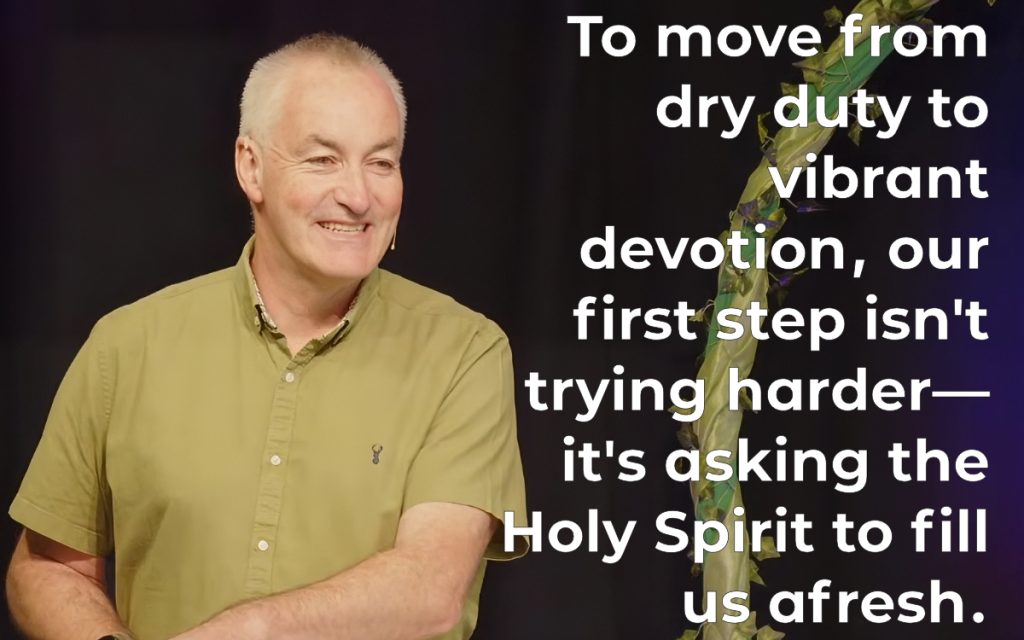
That word devoted is worth examining. Devotion is not duty. Duty is what you do because you feel you should. Devotion is what you do because something has changed inside you and you cannot imagine doing otherwise. The early church was not devoted because they were disciplined enough to show up. They were devoted because the Holy Spirit had descended upon them and set their hearts on fire.
This is the movement that matters: from duty to devotion.
Four Pillars Worth Building On
The first pillar is the apostles’ teaching, which for us is the New Testament, unlocking the fullness of the Old. The question it raises is whether every part of our shared life is marked by genuine, radical obedience to what God’s word actually says. Not selective engagement. Not comfortable agreement. Radical obedience.
The second pillar is the breaking of bread. In first-century culture, this was not only about communion, though it included that. It was about shared everyday meals. Eating together. Opening homes. Pulling up chairs. There is something about sitting around a table with another person that breaks down walls nothing else can touch. Radical generosity and hospitality were not programmes the early church ran. They were simply the way the early church lived. Whether it’s opening our tables for ‘Spare Seat Sunday’ or setting up open prayer lines throughout the week, it’s about turning our everyday lives into open doors.
The third pillar is prayer. The early believers prayed constantly, in temples and homes, in prisons and on beaches, on ships and in palaces, at midday and at midnight. They prayed for healing, for leaders, for those being persecuted. They prayed in their first moments as believers and in their final moments of life. There was nowhere they went and nothing they faced where prayer was not their instinct. The question for us is honest and direct: are there places we go where we do not think to pray? Are there moments we face where we rely entirely on ourselves?
The fourth pillar, and perhaps the one that holds all the others together, is fellowship. True fellowship. Not coexistence. Not polite acquaintance. But the kind of community where masks come off, where burdens are shared, where vulnerability is safe. Dietrich Bonhoeffer wrote in his book Life Together that it is grace, nothing but grace, that we are allowed to live in community with Christian brothers and sisters. That kind of fellowship is terrifying if we rely on our own emotional capacity. Naturally, we protect ourselves. We build walls. It is the kind of community where we are willing to lower our own ego so someone else can reach higher in their faith—like one girl on a high ropes course telling her friend, ‘You can stand on my head if you want. But when the Holy Spirit fills us, he replaces fear with love and replaces our defensive instincts with compassion.
The Inner Surgery We Cannot Perform on Ourselves
Here is the honest truth at the heart of all of this. We cannot manufacture devotion. We cannot grit our teeth and force ourselves to love more deeply, pray more consistently, or open our lives more generously. True devotion is not the product of trying harder. It is the direct result of being filled with the Holy Spirit.
Paul’s instruction in Ephesians chapter 5 is not a one-time event. It is a continuous posture: keep on being filled with the Holy Spirit. Daily. Repeatedly. Yielding again and again to the one who transforms from the inside out.
The invitation is not to make a resolution to be a better member of a community. Resolutions fade. The invitation is to yield. To say, Holy Spirit, come and fill me. Change what I love. Soften what has grown hard. Make me devoted.
When a community lives that way, something remarkable happens. People are drawn in. Lives are changed. The love becomes visible. And God adds to the number of those being saved.
That is not a programme. That is a promise.
0 Comments