
Names matter more than we often realize. In many cultures and throughout history, a name was never merely a label. It was a declaration. It was a window into identity, destiny, and purpose. Parents wrestle over names for their children, sometimes for weeks, debating syllables and meanings and family traditions. Yet when it came to the child born in Bethlehem, there was no debate, no family poll, no compromise. Two names were given by angelic announcement, and both of those names carry a weight that the world is still reckoning with today.
Emmanuel. Jesus.
These are not simply religious words to be repeated in carols and Christmas services. They are among the most radical, world-altering declarations ever spoken. To understand them properly is to find yourself standing at the very centre of what the Christian faith is actually about.
Emmanuel: God Has Moved In
Throughout the long sweep of the Old Testament, God made his presence known to his people, but always at a distance that felt impossible to fully cross. There was a burning bush that Moses could approach only so far. There was a pillar of cloud by day and fire by night, guiding the wandering people through the wilderness. There was the mountain of Sinai, where God descended in fire and smoke and the ground shook violently, and the people trembled at the foot of it. Even in Solomon’s magnificent temple, when the glory of God filled the building, it came in the form of thick, billowing smoke.
How much can you truly know of someone through smoke and fire? You can know something of their power. You can know something of their holiness. But you cannot know their face.
Then everything changed.
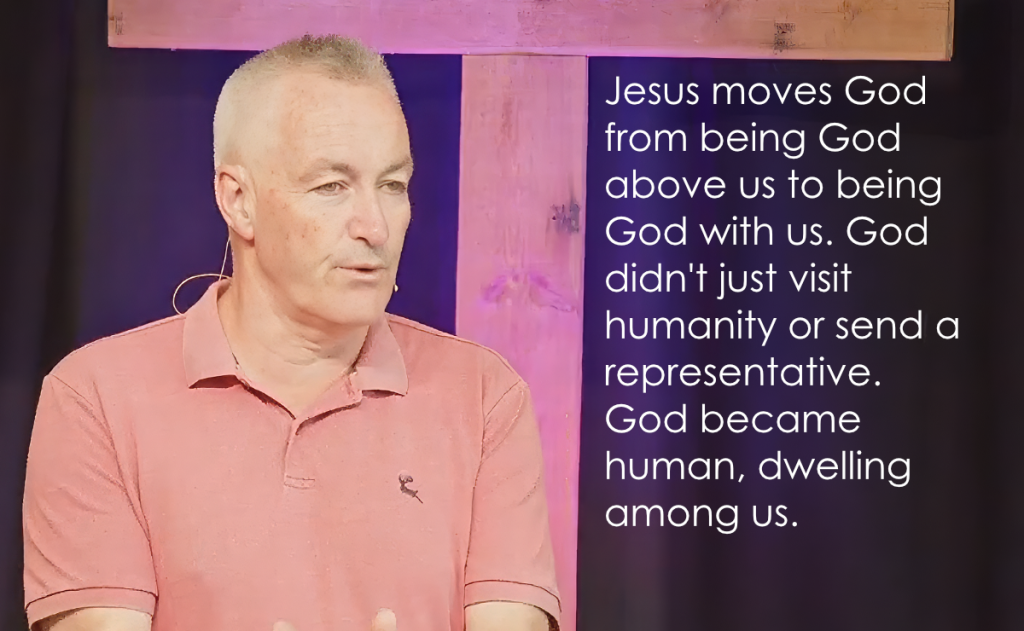
The word became flesh and made his dwelling among us. The Gospel of John captures it with breathtaking simplicity. God did not send a philosophy. He did not send a set of principles or a moral framework. He came. In Christ, as Colossians 2 describes it, all the fullness of God took up residence in a human body. Emmanuel is not a symbolic claim. It is a statement about the very nature of Jesus: God is with us.
Think of it this way. When a child is frightened in the night, hearing imagined monsters and shadows, a parent has a choice. They can stand at the end of the hallway and call out reassurances. There is nothing to fear. Go back to sleep. Or they can walk into the room, sit on the edge of the bed, and say simply: I am here. I am with you. It is the presence itself that brings peace, not just the words.
This is what God did in Jesus. He walked into the room. He sat down on the bed of human suffering and said: do not be afraid, for I am here. Emmanuel is not God shouting reassurances from a safe distance. It is God drawing near, entering our story, taking on flesh and bone and breath.
If you want to know what God is like, the most direct route available to you is to read the Gospels. Jesus himself said it plainly in John 14: anyone who has seen me has seen the Father. Jesus is, as one pastor put it, perfect theology. Every healing, every conversation, every meal shared with the overlooked and the outcast, every word of grace extended to the ashamed, is a window into the character of God.
Jesus: The Lord Who Saves
The name Jesus derives from the Hebrew Yeshua, meaning the Lord saves, or more literally, the Lord delivers into a wide, open, spacious place. It is a name with deep roots.
In the Old Testament, Moses led the people of Israel out of slavery in Egypt, through the sea, and toward freedom. It was an extraordinary act of deliverance. But Moses could not bring them all the way. The people remained bound by their own disobedience, unable to fully enter the rest that God had promised them. Then Joshua, whose name is the same root as Jesus, led the people into the promised land, into a place of rest and settlement. Yet even that was not the final word. The letter to the Hebrews notes in chapter 4 that if Joshua had fully delivered the rest God intended, there would have been no need to speak of another day of rest still to come.
There was always a greater Joshua coming. One who would not merely lead people into a geographical territory, but would break the very power of sin itself. Colossians 2 describes what Jesus accomplished on the cross in striking terms: he cancelled the record of charges against us, nailing it to the cross, and in doing so disarmed the spiritual rulers and authorities, shaming them publicly through his victory.
Jesus is the greater Joshua. He delivers not into a land, but into freedom. He saves not from a human empire, but from the oppression of guilt, shame, and sin. And his invitation remains open: come to me, all who are weary and burdened, and I will give you rest.
The Down and Outs Were First
It is worth pausing over who received the angelic announcement of this birth. Not kings. Not religious leaders. Not the socially respectable. Shepherds. People who occupied the lowest rungs of their society, the ones considered unreliable, the ones polite company preferred not to acknowledge.
This was not an accident. It was a pattern that defined the entire ministry of Jesus. He ate with tax collectors. He touched lepers. He stopped for the bleeding woman, the foreign woman, the woman caught in disgrace. He said plainly: I have not come to call the righteous, but sinners.
The table of Jesus has always been larger than anyone expected.
Three Questions Worth Sitting With
As these two names settle in the mind and heart, three questions are worth honest reflection.
Where do you need to recognize Emmanuel? In what place of sorrow, loneliness, or uncertainty do you need to stop striving and allow God-with-us to simply be present beside you?
Where do you need to surrender to Yeshua? What guilt, stronghold, or burden are you attempting to overcome in your own strength, when the true deliverer is already offering his help?
And whose place at the table needs to be made ready? Who is the unlikely, overlooked, or written-off person in your world that you could begin to welcome, long before any Christmas invitation is extended?
Emmanuel. Jesus. God with us. The Lord who saves. The names were given before the birth, and they remain just as true today.
0 Comments