
There’s a pool in Jerusalem that once drew crowds of desperate people. Near the Sheep Gate, surrounded by five covered colonnades, the Pool of Bethesda became a gathering place for those who had nowhere else to turn. The blind, the lame, the paralyzed—all waited there, hoping for a miracle when the waters stirred.
Among that crowd was a man who had been disabled for thirty-eight years. Thirty-eight years of watching others rush past him into the pool. Thirty-eight years of disappointment. Thirty-eight years of being stuck in the same place while life moved on around him.
When Jesus approached him, He asked what might seem like an obvious question: “Do you want to get well?”
The Power of a Simple Question
Why would Jesus ask such a thing? Surely after nearly four decades of suffering, the answer was obvious. But perhaps it wasn’t such a strange question after all.
Change is costly. After being disabled for so long, this man had settled into a pattern of life built around his disability. Being made well would mean leaving behind everything familiar, even if that familiarity was painful. It would mean stepping into an unknown future, taking risks, embracing uncertainty.
How often do we find ourselves in similar situations? We settle into patterns that harm us because they’re familiar. We stay in circumstances that limit us because change feels too risky. We convince ourselves that things can’t be different because we’ve tried before and failed.
The man’s response reveals his mindset: “I have no one to help me into the pool when the water is stirred. While I’m trying to get in, someone else goes down ahead of me.”
He could see a path to healing, but the odds seemed stacked against him. He had no one. He was alone in his struggle.
The Poverty of Isolation
This man’s situation wasn’t just about physical disability—it was about relational poverty. He had no one to help him. No one to advocate for him. No one to stand beside him in his time of need.
This resonates deeply with the reality of homelessness and poverty today. Portsmouth has one of the highest rates of homelessness of any local authority in the UK. Behind every statistic is a person who, like the man at Bethesda, often finds themselves with nowhere to go because they have no one to turn to.
Homelessness is rarely just about lacking resources. It’s about lacking relationships. It’s about the breakdown of support networks. It’s about being isolated in your struggle while the world rushes past.
When we walk through city centres and see people huddled in doorways, we face difficult questions. Should we give money? What if it’s not helpful? What if they’re not genuinely homeless? We can feel overwhelmed by the scale of need, paralyzed by our uncertainty about how to help.
But Jesus shows us something profound at the Pool of Bethesda: He helped one person.
The Worth of Helping One
Jesus could have healed everyone at the pool that day. He had the power. But He focused on one man. And that one life mattered.
When we’re confronted with overwhelming need, we often do nothing because we can’t do everything. We distance ourselves to protect our hearts from breaking under the weight of the world’s pain.
But Jesus didn’t avoid the Pool of Bethesda. He went there. He engaged. He saw one person and stopped.
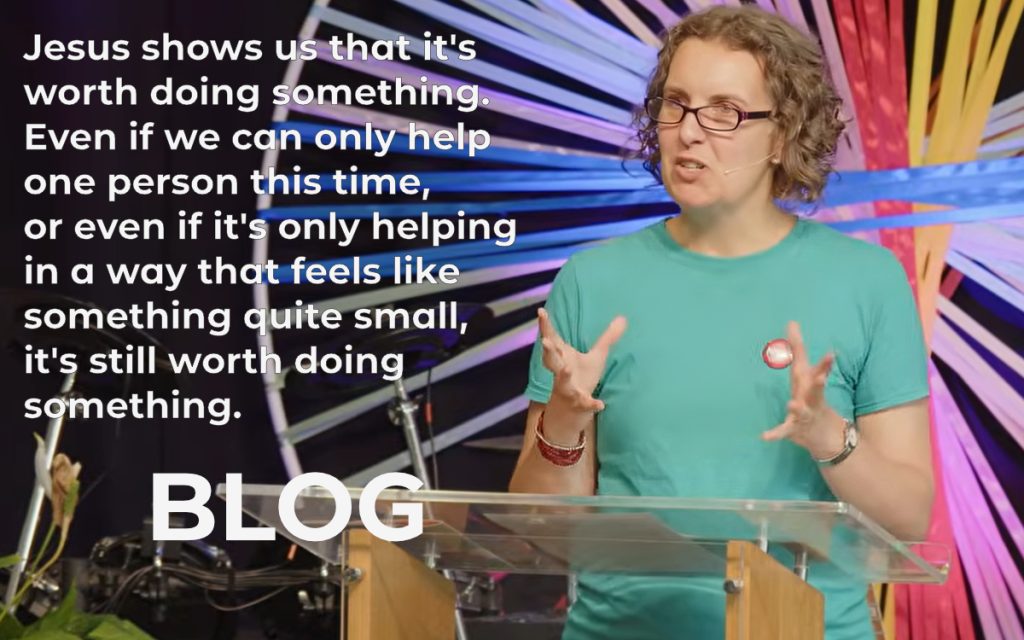
It’s worth doing something, even if it’s just one thing. Even if we can only help one person this time. Even if our contribution feels small in the face of massive need.
Following Jesus’ example means laying down our fears about getting involved, our preconceived ideas, our what-if questions. It means taking up courage to step outside our comfort zones, willingness to get involved, and the compassion Jesus showed to everyone He met.
Stand Up, Take Your Mat, and Walk
Jesus’ command to the man was simple but revolutionary: “Get up, pick up your mat and walk.”
Imagine the faith it took to stand on legs that hadn’t worked for thirty-eight years. The man had to lay down his doubts, leave behind the life he’d known, and choose hope. He had to trust enough to take up his mat and walk into a new future.
This image of a man carrying his mat and walking out of his old life speaks powerfully to anyone stepping into new beginnings. Some people travel light into their new life, carrying only a couple of bags. Others arrive with everything they own stuffed into black sacks—years of accumulation from trying to meet basic needs, holding onto whatever they could find.
The journey of healing and recovery involves unpacking. Sorting through the clutter. Deciding what to lay down and let go of, and what to take up and hold on to.
Among the pain and trauma that people carry, there are also stories of survival and strength. When we create safe, nurturing environments with good support networks, people find the motivation and hope they need to make lasting changes—leaving behind what is harmful and taking up new coping skills and healthier patterns.
The Transformation Continues
The work of restoration isn’t quick or straightforward. People with complex lives don’t experience healing on a predictable timeline. There are setbacks and struggles. But the results speak to God’s transformative power working through committed relationships.
When people experiencing homelessness receive not just housing but genuine support and community, remarkable things happen. Mental health improves. Relationships heal. People find employment, pursue education, and rediscover purpose. Some even open their hearts to prayer and faith.
One person who found housing after years of instability said it simply: “After feeling unsafe for many years, I’ve found calm and peace.”
Our Response
The story of Bethesda challenges us to examine our response to need around us. What do we need to lay down? Perhaps our fears, our assumptions, our comfort, our excuses about being too busy or not knowing enough.
What do we need to take up? Courage, compassion, commitment to doing something even when we can’t do everything.
The man at Bethesda didn’t even know who Jesus was when he was healed. Jesus poured out healing grace simply because He had compassion. He saw someone in need and responded.
As followers of Jesus, we’re called to the same compassion—to see people, to stop, to engage, to help carry the mat, to walk alongside those taking courageous steps toward new life.
The question Jesus asked that day echoes still: “Do you want to get well?”
For those struggling, it’s an invitation to hope, to risk change, to trust again.
For those who have much, it’s a different question: Will you help someone stand up and walk?
0 Comments