
We live in a world that increasingly feels foreign to those who follow Christ. The familiar landmarks of Christian culture have faded from view. Shops once closed on Sundays now operate around the clock. Schools that once openly taught Christian values now navigate complex secular frameworks. The moral boundaries that once shaped relationships have shifted dramatically.
Sound familiar? This isn’t just nostalgia talking—it’s the recognition that we, like Daniel of old, are living in exile.
Welcome to Digital Babylon
The book of Daniel opens with a young man torn from everything he knew. Jerusalem, his home, became a distant memory as he was forced into Babylon—a land with a new name for him, a new language to learn, and a completely foreign pagan culture to navigate. Daniel had to adjust to life in an empire that neither knew nor honored his God.
We face a similar reality today. We’re living in what might be called a “digital Babylon”—a world dominated by technology, entertainment, and knowledge that seeks to control our lives just as ancient Babylon demonstrated its might to the world. The power structures have changed, but the challenge remains the same: How do we live faithfully when we’re no longer at home?
As Peter wrote in his letter, we are “foreigners and exiles.” We are no longer in Eden. We are no longer in Jerusalem. We are living in Babylon.
The Surprising Strategy for Exile
So what should our response be? Should we campaign loudly to drag culture back to “the way things were”? Should we fight to reclaim the land for Christianity? Is Christian nationalism the answer?
Scripture offers a radically different approach. In Jeremiah 29, God speaks to the exiles with unexpected instructions: “Seek the peace and prosperity of the city to which I have carried you into exile. Pray to the Lord for it, because if it prospers, you too will prosper.”
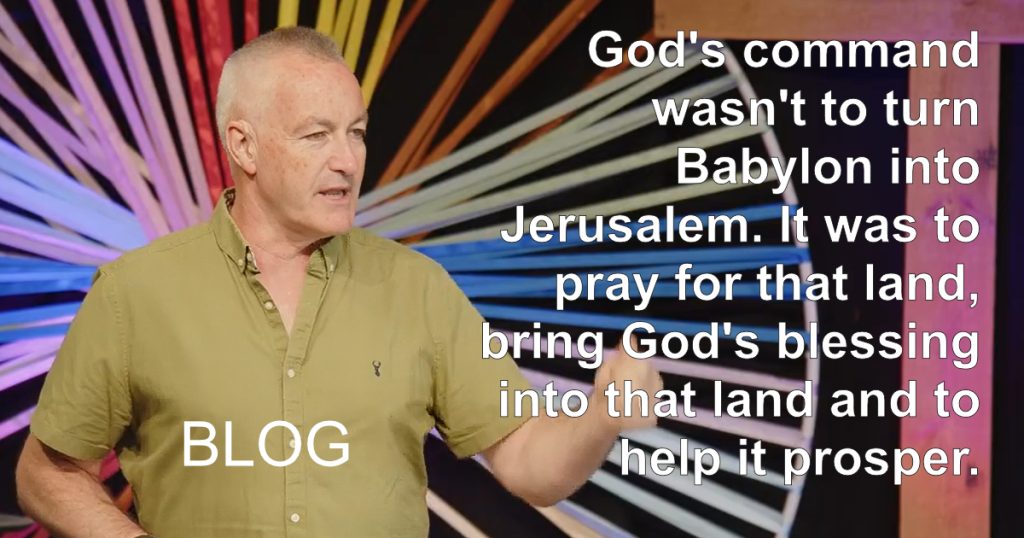
Read that again. God didn’t command the exiles to turn Babylon into Jerusalem. He told them to pray for Babylon, to bring God’s blessing into that land, and to help it prosper.
This pattern continues in the life of Jesus. When He arrived, Israel was under oppressive Roman occupation. The people desperately wanted a militaristic savior to give them their country back. They hated the collusion with Rome. But Jesus flatly refused to adopt their nationalistic expectations.
Instead, Jesus spoke of another kingdom—one that would unify people from all nations. He praised the faith of a Roman commander. He made a cultural enemy, a Samaritan, the moral hero of neighborly love. He blessed the poor, the meek, the merciful, the pure in heart, and the peacemakers. He declared that His kingdom was not from this world.
The crowd didn’t always like this approach. When Jesus reminded them that Elijah was sent to a widow in Sidon and Elisha healed a Syrian, the people were furious. Their rage revealed the danger of religious nationalism—it vilifies the stranger as dangerous and untrustworthy, while Jesus applauds the stranger and acknowledges their faith.
Daniel’s Playbook for Winning Away from Home
In sports, it’s notoriously difficult to win away from home. The home team has the crowd, the familiar changing rooms, the pitch cut to their specifications. Away from home, everything works against you.
Yet Daniel gives us a strategic playbook for how to win even when we’re playing away from home—even as exiles and foreigners in a strange land.
Daniel’s approach had two key components: his posture and his practices.
The Right Posture: Radical Allegiance, Radical Blessing
Daniel maintained a posture of radical allegiance to God while seeking to radically bless the empire where he lived. He didn’t just declare everything bad and try to escape. He recognized that Babylon could be made better. He could be salt and light wherever he was placed.
Daniel didn’t just accept his new circumstances—he distinguished himself. He became the top administrator. He passionately demonstrated God’s love, faithfulness, and goodness. He wanted the best for that country.
This is the challenge for us: Can we say that in all we do—in our workplaces, on our streets, in our cities—we want the best? Will we do all we can to bring blessing, even to a culture that doesn’t share our values?
When King Darius looked at his administrators, Daniel stood out. Not because he was the loudest or the most politically savvy, but because of his faithfulness, honesty, integrity, love for people, and care for his work. The king recognized that Daniel was “a cut above the rest.”
The question for us: Would our managers or colleagues say the same? Are we known for our integrity and honesty? Are we distinguished by the way we want the best for our company or community?
The Right Practice: Unwavering Spiritual Disciplines
Daniel didn’t just have the right posture—he had the right practices. When a decree went out banning prayer to anyone except the king, Daniel didn’t change his routine. He went home, opened the window, and prayed as he always did—three times a day, facing Jerusalem.
Daniel’s spiritual disciplines kept him connected to God and in constant communication with Him. This is crucial because, as Peter warns, “Your enemy, the devil, prowls around like a roaring lion looking for someone to devour.”
We live in a dangerous secular world. We need to stay close to God through spiritual disciplines—Bible reading, meditation, worship, giving, fasting, solitude, fellowship, service, and prayer.
Digital Disciplines for a Digital Babylon
Living in a digital age requires some specific considerations. Ask yourself these honest questions:
- Is checking your phone the very first thing you do when you wake up and the very last thing before closing your eyes?
- Do you feel anxious, bored, or restless if you have to sit in silence without a podcast, music, or notifications?
- Does your mind feel constantly hurried or distracted, making it difficult to read Scripture or pray without wandering?
If any of these resonate, the noise of Babylon may be drowning out the still, small voice of God.
Consider implementing some digital disciplines:
Create phone-free zones: Keep the first and last 30 minutes of your day phone-free.
Practice solitude: Turn off all devices for a period each day. Go for a walk with nothing in your ears except what God wants to say.
Choose the slow lane: Deliberately select the slowest checkout line or traffic lane. Use that time to acknowledge God rather than rushing.
Do good in secret: Perform acts of kindness without posting them online. Break free from performing for human approval.
Take a news fast: Choose one day a week to avoid news and social media. Delete apps that cause endless scrolling and anxiety.
Engage with real people: Make it a discipline to share meals at a table, to know people who are different from you, to connect beyond screens.
The Gospel Parallel
The story of Daniel contains a beautiful gospel parallel. Daniel was falsely accused and thrown into a pit of lions. A stone was rolled over the mouth. Yet he was found miraculously alive, and the king issued a decree changing the policy of the land.
Jesus was falsely accused and thrown into the pit of a tomb. A stone was rolled over the entrance. He was miraculously raised to life, changing the eternal destiny of the cosmos.
If you choose to live as a blessing to the world around you while keeping God as your ultimate master, you don’t need to fear Babylon. With Christ, you can get that “away win.” You can win away from home.
Starting Today
Perhaps you’re thinking, “That’s too tough. I’ve already failed. I haven’t lived up to that standard.”
Today is a new day. Today is a day to start now. Live that life of integrity from now. Live that life of honesty from now. Establish those spiritual disciplines from now. Put God first from now.
Make the decision today. Babylon is not going to control you. God is going to control you. And when you live like this—with integrity, honesty, and unwavering devotion to God—others will notice. They may criticize, laugh, or even oppose you. But they’ll also see something different, something authentic, something that points beyond this foreign land to your true home.
You are an exile, yes. But you are an exile on a mission—to seek the peace and prosperity of your city, to be salt and light, and to demonstrate that even in Babylon, God’s kingdom is breaking through.
0 Comments