
In the rolling hills of southeastern Malawi, a devastating cyclone swept through the village of Impupu, reducing homes to rubble and leaving families sheltering in school buildings. Mothers like Lexa and Esnat stood where their houses once stood, surrounded by nothing but debris. Men foraged desperately for work to bring home even the smallest amount of food. Yet amid this devastation, something remarkable persisted: children played with a homemade toy, sharing the single plaything among many. A man sat with a smile, strumming a handcrafted guitar. Even in profound loss, creativity and resilience remained.
This scene mirrors a story told two thousand years ago on a mountainside by the Sea of Galilee.
The Question That Changes Everything
When Jesus looked up and saw a great crowd approaching, hungry and far from home, he turned to Philip with a question: “Where shall we buy bread for these people to eat?” The Gospel of John tells us Jesus already knew what he was going to do. This wasn’t a question born of anxiety but of invitation—an invitation for others to participate in meeting an overwhelming need.
Philip’s response sounds painfully familiar: “It would take more than half a year’s wages to buy enough bread for each one to have a bite.” In other words, the need is too big. The resources are too small. There’s no point in even trying.
But then Andrew speaks up, tentatively presenting what seems absurdly insufficient: a boy with five small barley loaves and two small fish. “But how far will they go among so many?”
Here lies a principle woven throughout Scripture, one we often miss in our rush to solve problems: God deliberately works through what seems inadequate. He invites our participation, multiplies our small offerings, and ensures everyone plays a part.
The Pattern of Divine Multiplication
The feeding of the five thousand reveals a consistent pattern in how God transforms lives and communities. Jesus didn’t simply speak food into existence. He engaged others. He asked questions. He identified existing resources, however meager. He organized people. He gave thanks for what was available. He distributed through his disciples. And then—only then—did the miracle unfold.
Notice what had to happen: a boy had to be willing to share his lunch. Andrew had to overcome his doubt and bring the boy forward. Philip had to wrestle with the impossibility. The disciples had to organize the crowd. The people had to sit down in expectation. Everyone participated.
And at the end? Twelve baskets of leftovers—all from those same five small barley loaves and two little fish. The abundance came from the original gift, multiplied beyond imagination.
From Dependency to Dignity
This biblical principle stands in stark contrast to much of how we approach helping others. Too often, our instinct is to do things for people rather than with them. We see a need and rush to fill it, inadvertently creating dependency rather than empowerment.
In Malawi, one of the world’s poorest countries where 85% of people survive on what they can grow, this pattern has played out repeatedly. Well-meaning aid can sometimes leave communities waiting for the next handout rather than discovering their God-given capacity to solve problems.
But when communities are guided through a different approach—one that awakens them to the resources already present, helps them prioritize their own needs, and teaches them to problem-solve creatively—transformation takes root in sustainable ways.
The villagers of Impupu didn’t wait for outside organizations to rebuild. They mapped their resources. They obtained tree saplings from the government and planted them individually, watering each one by bucket to protect future crops from cyclones. They grew vegetables on the roofs of their mud huts. They identified wetland areas near rivers that stayed damp year-round and began cultivating food there. They multiplied chickens to share with other families.
When they identified irrigation as a critical need, they didn’t simply request pumps. They developed models where groups of families could rent equipment together, eventually paying enough to provide pumps for other families—sustainability built on dignity.
The Burden We Were Never Meant to Carry
Perhaps you’ve looked at the overwhelming needs around you—in your community, in your world—and felt the weight of impossibility. Like Philip, you’ve calculated the cost and concluded it’s beyond reach. Or perhaps you’ve run yourself ragged trying to meet every need, carrying a burden of responsibility that leaves you harassed and exhausted.
The feeding of the five thousand offers profound relief: we’re called to give what we have, not to produce what we don’t.
The boy didn’t have a feast—just his lunch. But he gave it. The disciples didn’t have answers—just willingness to participate. Andrew didn’t have certainty—just enough courage to mention the inadequate option. And Jesus took it all and did what only he could do.
When Jesus looked at the harassed and helpless crowds, he felt compassion. That same compassion extends to us when we’re overwhelmed by needs we cannot meet. He invites us to release the burden of outcomes we were never meant to control and instead offer the small thing we actually possess.
Everyone Has a Part to Play
The miracle required everyone: the boy, Andrew, Philip, the other disciples, the crowd willing to sit down, and Jesus himself. Remove any piece, and the story changes.
This remains true today. Transformation in struggling communities requires the communities themselves to engage their gifts. It requires local churches to awaken to their calling. It requires governments to fulfill their responsibilities. It requires organizations to share knowledge and resources. It requires individuals across the globe to pray, give, and learn.
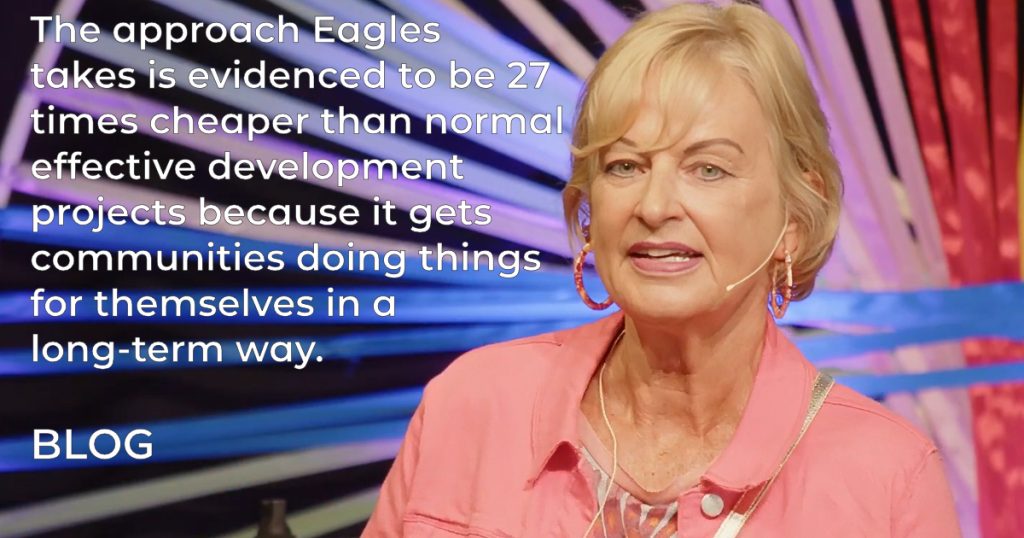
The evidence is compelling: when communities mobilize using their own God-given resources and creativity, transformation happens at a fraction of the cost of traditional aid—27 times cheaper, in fact, while being more sustainable and dignified.
What Will You Give?
Somewhere today, a child is playing with a homemade toy, sharing joy despite having little. Somewhere, a mother is planting seeds in unlikely places, believing in future harvest. Somewhere, a community is gathering to problem-solve together, discovering they’re not as helpless as they thought.
And somewhere, perhaps in your own heart, there’s a small offering—time, resources, prayer, compassion—that seems insufficient for the overwhelming need you see.
The invitation remains the same: bring what you have. Let God multiply it. Join in distributing the abundance. And watch as everyone has enough, with baskets left over.
The miracle isn’t just in the multiplication. It’s in the participation—in discovering that when we all play our part, however small, God’s power and love are released in ways beyond what we can ask or imagine.
0 Comments