
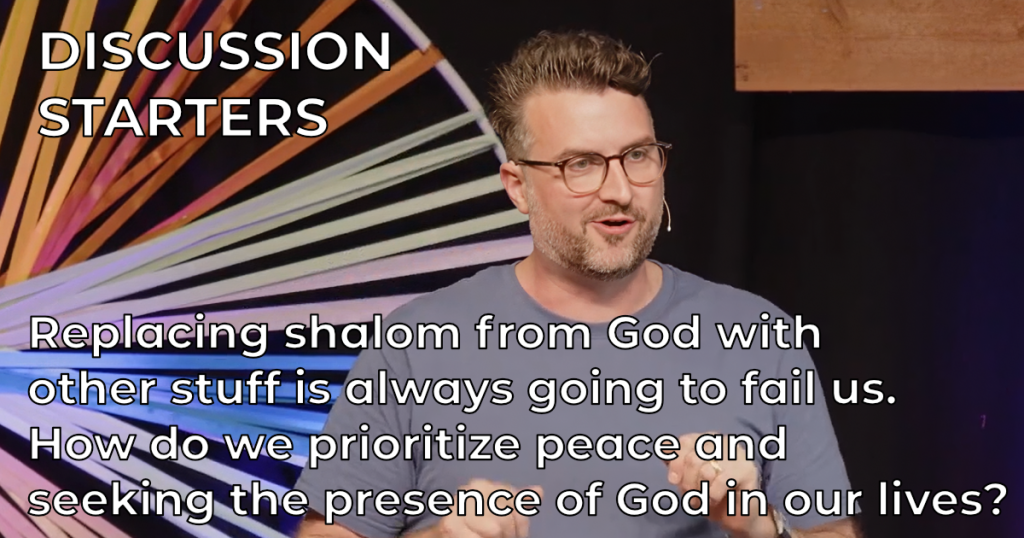
Here are some family-friendly discussion starters drawn from the sermon. You can pick a few each meal rather than trying to do them all at once.
1. Story Shape & Our Lives
- The sermon said most stories go: good → bad → good again.
- Can you think of a film or book that follows that pattern?
- Where do you think we are in God’s big story right now: good, bad, or “on the way to good again”?
- Eden was described as a place where people walked with God and things were “very good.”
- What do you imagine Eden was like?
- What would a “perfect day” look like for you?
- The preacher talked about feeling “exiled” or like you don’t quite belong.
- Have you ever felt like that—at school, work, church, or even in your own family?
- What helped, or what do you think would help in those moments?
2. Peace (Shalom) & God’s Presence
- Shalom means more than “no fighting”; it means everything working as it should.
- Where, in your life right now, do you most feel this kind of peace?
- Where do you feel the opposite of shalom?
- The sermon said: “True peace is found in the presence of God.”
- What do you think it feels like to be in God’s presence?
- Can you remember a time you felt especially close to God?
- When you’re stressed, sad, or worried, what do you usually turn to first for comfort (e.g., phone, TV, food, friends, hobbies)?
- Do those things give you real peace, or just a distraction?
- What would it look like to turn to God first?
3. Tabernacle, Temple & Jesus
- The tabernacle was a traveling tent where God met with His people.
- If you had to design a special “meeting place with God,” what would it look like?
- What would be most important about it?
- Only one high priest, once a year, could go into the most holy place in the temple.
- What does that tell you about God’s holiness and how special His presence is?
- When Jesus died, the temple curtain was torn from top to bottom.
- What do you think God was saying by doing that?
- How is our access to God different from how it was in Solomon’s time?
- The sermon said Jesus is like the true temple, and the church is now His body.
- In what ways is our church like a “temple,” a place of God’s presence?
- How can our home be more like a “little temple” where God’s presence is welcomed?
4. The Church & Each of Us
- “You lot are the body of Christ, and each one of you is part of it.”
- What part do you think you play in the body of Christ (e.g., encourager, helper, listener, practical do-er, prayer)?
- What parts do you see in other family members?
- If someone watched our family for a week, what would they learn about what we really think is important?
- Would they see that God is at the center, like the tabernacle was at the center of Israel’s camp?
- What is one small way our family could help other people experience God’s peace this week (e.g., invite someone over, write a note, pray for someone, share something we have)?
5. Priorities & Solomon’s Example
- Solomon spent 7 years building God’s temple but 12 years on his own palace.
- What does that suggest about his priorities?
- If someone looked at how we use our time and money, what would they think our priorities are?
- Solomon asked God for wisdom.
- If God asked each of us, “What do you most want Me to give you?” what would you say?
- Is there something we could start asking for regularly as a family (e.g., wisdom, love, courage, peace)?
- Later in life, Solomon’s heart was “not wholeheartedly devoted to the Lord.”
- What kinds of things pull our hearts away from God today?
- How can we help each other to keep our hearts devoted to Him?
6. Habits of Seeking God’s Presence
- The sermon suggested: starting the day in prayer, using Bible apps, memorizing Scripture, and choosing prayer instead of scrolling.
- Which of these sounds most doable for you right now?
- What’s one tiny change you could try this week?
- When you get a spare moment, what’s your “default” thing to do (phone, games, work, chores, chatting)?
- What might it look like to occasionally swap that with a short prayer or a Bible verse?
- Jesus said, “If you love me, you will obey my commands.”
- Do you know one of Jesus’ commands that you find especially challenging?
- How could our family support each other in obeying Jesus in that area?
- The preacher distinguished between learning the Bible “by memory” and learning it “by heart.”
- What do you think is the difference?
- Is there a verse we could learn together this week and talk about what it means?
You could end each meal with one simple action:
- One person thanks God for something peaceful today.
- One person asks God to help your family seek His presence more than anything else.
The Adult designed questions
How does the pattern of stories starting good, turning bad, and ending good again reflect your own spiritual journey and understanding of God’s redemptive work in history?
In what ways do you experience a sense of exile or not belonging in your daily life, and how might seeking God’s presence address that longing?
The sermon describes shalom as more than absence of conflict but as flourishing and living as God intended. What would true shalom look like in your life right now?
Solomon asked for wisdom to discern right from wrong, but the sermon suggests he might have missed asking for God’s presence throughout his life. What does this reveal about the difference between gifts from God and God himself?
The temple was designed with the presence of God at the center of Israel’s national life. What is at the center of your life, and how might you restructure your priorities to make God’s presence central?
Jesus tearing the temple curtain from top to bottom opened access to God’s presence for everyone. How does understanding yourself as part of Christ’s body and temple change how you view your relationship with God?
Where do you honestly turn for peace when life becomes difficult: to God’s presence, or to blessings like family, work, food, or entertainment? How can you recognize when good things become replacements for God?
Solomon spent seven years building God’s temple but twelve years building his own palace. What does the allocation of your time, money, and attention reveal about your true priorities?
The sermon challenges us to turn to God in prayer during free moments instead of defaulting to phones or news. What practical step could you take this week to redirect your attention-seeking habits toward seeking God’s presence?
Jesus said if you love me you will obey my commands. How can you grow in both knowing God’s commands through Scripture and allowing them to settle in your heart rather than just your mind?
0 Comments