
Here are some simple, family‑friendly discussion starters you can use at the table. You don’t have to use them all at once—pick a few that fit your family and the ages of your kids.
1. “If Only…” and the Party Picture
- The preacher talked about a big party we’re invited to.
- What do you think that “party” represents in real life?
- How does it feel to know God actually wants you there?
- Have you ever felt like you were “outside” and not included in something?
- What helped you feel included again?
- How might God be saying, “You’re meant to be in here” to you?
2. God’s Promise: “When” Not “If”
- God kept saying “when you enter the land,” not “if you enter the land.”
- What does that tell us about how sure God’s promises are?
- Can you think of a time when something took a lot longer than you expected (like their 11‑day journey taking 40 years)?
- Did the delay change your trust or patience? How?
3. Complaining vs. Trusting
- The Israelites complained a lot, even after God rescued them.
- Why do you think they complained so much?
- Are there times we complain even though God has already helped us?
- What’s one thing we’re tempted to grumble about as a family?
- What would it look like to talk to God about it instead of just complaining?
4. Fear or Faith? The Spies’ Report
- Ten spies focused on the giants and the walls; two (Joshua and Caleb) focused on God.
- What’s the difference between looking at problems with fear and looking at them with faith?
- What is a “giant” in your life right now? (Something that feels too big or scary.)
- If you look at that “giant” with faith instead of fear, what changes?
5. How We Think: Taming Our Thoughts
- The sermon mentioned “uprooting” wrong thoughts and “replanting” God’s truth.
- Can you name one unhelpful thought you sometimes have?
- What Bible truth could replace it?
- As a family, what’s one verse we could “plant” together and remember when we’re afraid?
- (Ideas: Joshua 1:9, Isaiah 41:10, Psalm 23:4, Romans 8:31.)
6. Jesus and the New Kingdom
- The preacher said Jesus is like:
- A greater Moses (who defeats evil and death)
- The Passover lamb (who saves us)
- The bread from heaven (who sustains us)
- The Joshua who leads us into the new kingdom
- Which of those pictures of Jesus means the most to you, and why?
- He also said God doesn’t say “if you enter my kingdom” but “when you enter.”
- What does it mean, practically, to “live in God’s kingdom” today as a family?
7. Baptism and Saying “Yes”
- The sermon challenged people about baptism—showing publicly that we belong to Jesus.
- For those who are baptised: What do you remember about it? What did it mean to you?
- For those who aren’t: What questions or worries do you have about baptism?
- If baptism is like saying, “Yes, I’m in God’s kingdom and at his party,”
- How could we keep saying “yes” to Jesus in everyday choices this week?
8. Helping Each Other with Fear
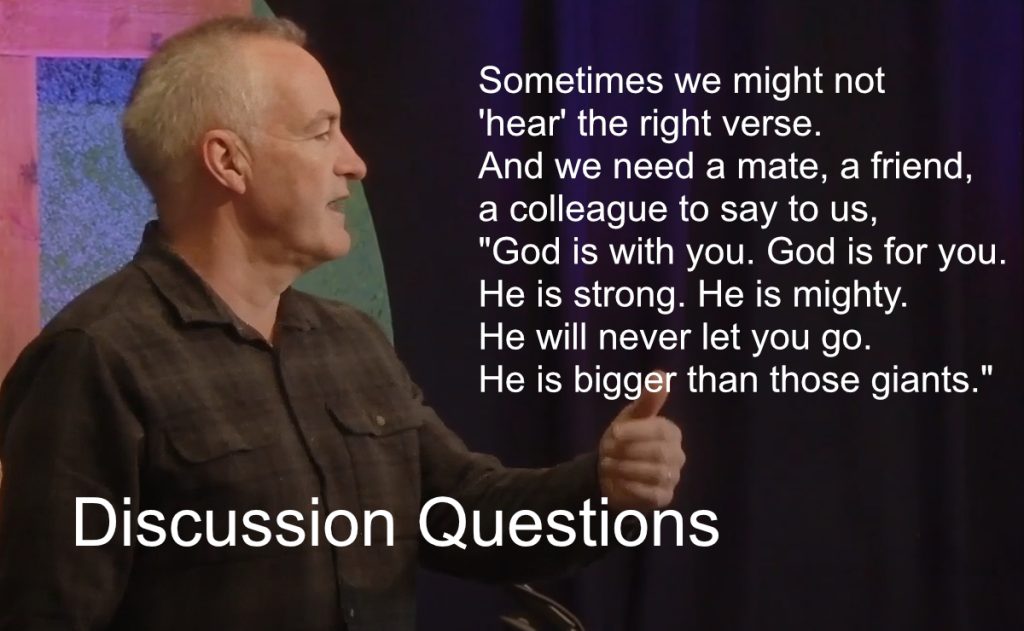
- The preacher said sometimes we need a friend to remind us, “God is with you.”
- How can we do that for each other in this family?
- When someone in our family is scared or worried,
- What helps the most: listening, praying together, reading a verse, a hug, something else?
- How can we get better at doing that for each other?
The Israelites turned an 11-day journey into 40 years of wandering. What areas of your life might God be inviting you forward in, but fear or doubt has kept you circling?
God repeatedly said ‘when you enter the land’ rather than ‘if you enter.’ How does God’s certainty about His promises challenge the way you view your own spiritual journey?
The sermon compares Jesus to Moses, the Passover lamb, the bread of heaven, and Joshua. Which of these images resonates most with your current experience of faith, and why?
Ten spies focused on the giants while two focused on God. When facing challenges, what determines whether you respond with fear or faith?
The preacher challenged everyone to either be baptized or planning to be baptized. What does baptism represent in your understanding of publicly declaring faith in God’s kingdom?
Max Lucado’s concept of UFOs (Untruth, False narrative, Overreaction) describes how fear escalates. Can you identify a current fear in your life that might be following this pattern?
David saw Goliath as speaking against God’s armies, not just Israel’s army. How might viewing your challenges as God’s battles rather than just your own change your perspective?
The sermon mentions needing friends to remind us that God is with us when we cannot hear it ourselves. Who in your community helps speak truth to your fears, and for whom do you play that role?
God remained faithful to the Israelites despite their constant complaining and mistakes. How does understanding that God’s promises depend on His character rather than our performance affect your relationship with Him?
What specific Bible verse could you ‘plant’ in your heart to replace fear-based thoughts when facing your personal giants, and how will you commit it to memory?
0 Comments