
In our culture of selfies, personal branding, and curated social media feeds, we’re all tempted to see ourselves as the main character of the universe. We carry the weight of constructing our own identity, building our own legacy, and charting our own course. It’s exhausting, isn’t it?
But what if the greatest freedom we could experience is discovering that we’re not the main character after all?
The Story That Changes Everything
The Bible presents us with a radically different narrative than the one our culture promotes. It’s not primarily your story or my story—it’s God’s story. And the breathtaking news is that this God, who spoke creation into existence, who holds the stars in place, who sees the end from the beginning, has invited us into His narrative.
When we open Genesis 12, we encounter a man named Abram, living his life in a place called Ur (modern-day Iraq). He’s wealthy, but he lacks the one thing that mattered most in his culture: children, legacy, a future. His name means “exalted father,” which must have felt like a cruel joke every single day.
Then God shows up.
“Go from your country, your people and your father’s family. Go to the land I will show you.”
No GPS coordinates. No detailed itinerary. No promise that the journey would be easy. Just a command to go and a series of promises about what God would do.
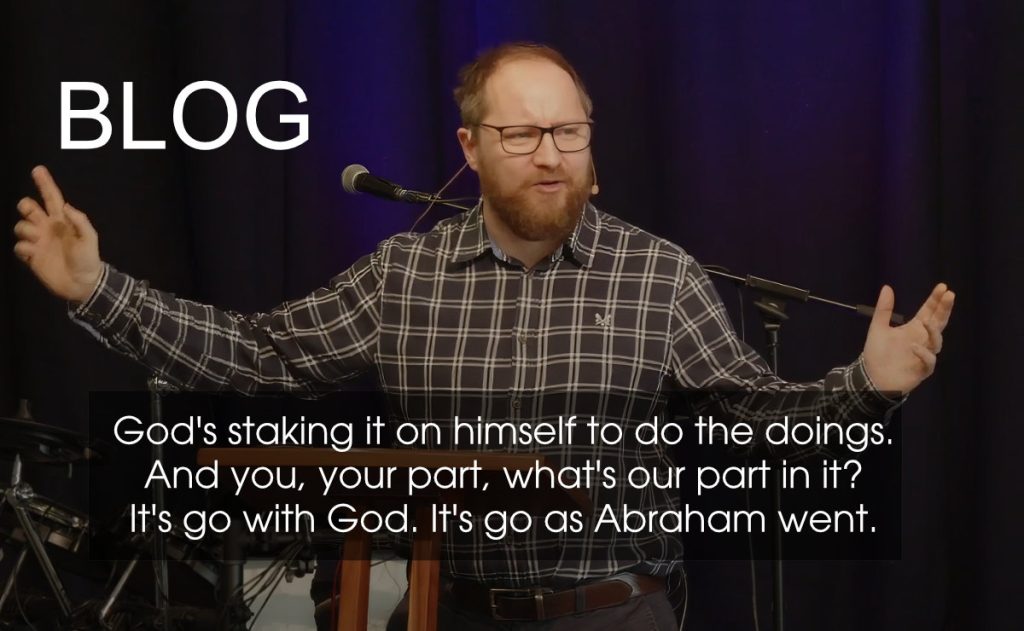
Notice the pattern: “I will make you into a great nation. I will bless you. I will make your name great.” Five times in three verses, God stakes everything on His own action, His own faithfulness, His own power to accomplish what He promises.
This is where the story shifts from humanity spiraling away from God (as we see in the fall and the flood) to God actively pursuing and redeeming His people. It’s not just restraining evil anymore—it’s the positive work of bringing people back.
Faith: Not a Leap, But a Walk
We often hear about “leaps of faith,” as if following God is like jumping off a cliff and hoping someone catches you. But Scripture characterizes the life of faith differently—as a walk. Abraham didn’t leap to an unknown destination; he walked, step by step, with a God he was learning to trust.
The Apostle Paul later reflects on Abraham’s story and makes this stunning statement: “Abraham believed God, and it was credited to him as righteousness.”
What does that mean? Simply this: Abraham trusted God when God said “go,” and that trust—not his performance, not his moral perfection, not his impressive resume—made him right with God.
This changes everything about how we approach our relationship with God. We spend so much energy trying to impress Him, trying to tick the right boxes, trying to earn His approval. But God’s pattern, from Abraham forward, is to extend grace before obedience, to call us before we’ve proven ourselves worthy.
He apprehends us in the middle of our ordinary lives and says, “Come with me. I have something better for you than what you’re building on your own.”
Blessed to Be a Blessing
Here’s where the story gets even bigger. God doesn’t just promise to bless Abraham for Abraham’s sake. He says, “All nations on earth will be blessed because of you.”
From the very beginning, God’s heart beats for all peoples, all tribes, all tongues. The promise to Abraham wasn’t about creating an isolated, exclusive club. It was about creating a people who would be a conduit of blessing to everyone else.
This theme echoes throughout Scripture. The prophet Isaiah records God saying to His servant (ultimately Jesus): “It’s too light a thing that you should be my servant to raise up the tribes of Jacob… I will make you as a light for the nations, that my salvation may reach to the end of the earth.”
When we fast-forward to the book of Revelation, we see the fulfillment of this promise. John hears a list of the tribes of Israel being read, but when he turns to look, what does he see? “A multitude that no one could count from every tribe and every nation, every tribe and every tongue.”
God’s story has always been bigger than we imagined. And we’re invited into it—not as spectators, but as participants.
The Freedom of Knowing Your Place
There’s a paradox at the heart of the Christian life: we find freedom not by asserting our independence, but by surrendering to God’s purposes. We discover who we truly are not by constructing our own identity, but by receiving the identity He gives us.
Think of a sheepdog, bred for generations to herd sheep. When it’s finally released into a field with a flock, it doesn’t need training or instruction—it comes alive, operating exactly as it was created to operate. It’s fully, joyfully, completely itself.
That’s what God wants for each of us: to be fully human, fully alive, operating in the joy and freedom of the purpose for which we were created. And to be fully human is to be human in relationship with Him, imaging Him to the world, participating in His mission of redemption.
This means we can lay down the crushing burden of being our own savior, our own source of meaning, our own ultimate reference point. We’re not NPCs (non-playable characters) wandering aimlessly through someone else’s game. But neither are we the main character carrying the weight of the entire story.
We’re beloved participants in a story written by a God who loves us beyond measure, who has numbered our days, who knows us intimately, and who invites us to walk with Him.
Your Invitation Today
Wherever you are in your journey—whether you’ve walked with God for decades or you’re wildly skeptical about all of this—the same invitation extends to you today that extended to Abraham thousands of years ago:
Go to the place I’m sending you. Trust me.
Trust that He is full of love. Trust that He is building something eternal and beautiful. Trust that your life, which might feel small and insignificant, is treasured beyond measure by the living God.
The question isn’t whether you have main character energy or feel like a background extra. The question is whether you’ll take the hand of the One who created you, who loves you, who died for you, and who says, “Come. Walk with me. I have more for you than you can imagine.”
That’s not a leap. That’s a step. And it’s a step worth taking.
0 Comments