
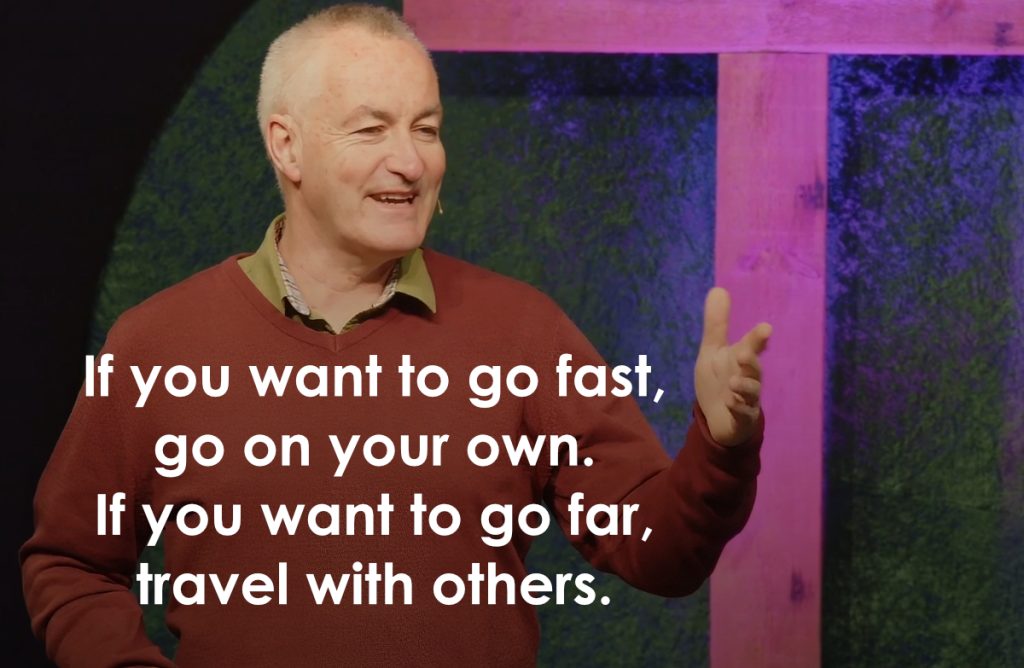
There’s a powerful myth that has taken root in our modern world: the idea that faith is a private, solo journey—just me, my Bible, and whatever strength I can muster against the world. It’s the spiritual equivalent of being a lone ranger, riding off into the sunset with no one beside us. But when we look closely at the life of Jesus and the early church, we discover something radically different. Faith was never meant to be walked alone.
The Way, Not the Destination
In the earliest days of Christianity, believers didn’t even call themselves “Christians” at first. They were known as followers of “The Way.” This title is significant. It implies movement, a path forward, a journey in progress. Being a disciple of Jesus isn’t about arriving at a destination where we can finally rest and say, “I’ve made it.” Instead, it’s about maintaining a pace, staying on the path, and crucially—walking it with others beside us.
The question we must ask ourselves is simple but profound: Who are you walking with? Who is carrying your pack when you’re too exhausted to continue? And who are you helping to stay on the path when they’re ready to give up?
The Ancient Wisdom of Traveling Together
In the ancient Near East, travelers crossing the desert would form caravans. They didn’t do this casually or for social reasons alone. Caravans served three critical purposes: protection from thieves, provision through shared food and water, and perspective—when one person got lost, others knew the way.
This ancient practice holds profound spiritual truth. When we journey together in faith, we offer each other protection from spiritual attack, we share the sustenance of encouragement and wisdom, and we provide perspective when someone loses their way or their hope.
Consider the Roman soldiers who locked their shields together, knowing they were stronger as a unit. Think of the gold rush prospectors who traveled in groups because they needed mutual encouragement and protection. These weren’t signs of weakness—they were strategies for survival and success.
The Road to Emmaus: When Walking Together Isn’t Enough
Luke 24 gives us a fascinating glimpse into two followers of Jesus walking together to the village of Emmaus, about seven miles from Jerusalem. They’re talking intensely about everything that had happened—the crucifixion, the confusing reports of an empty tomb, their shattered hopes that Jesus would rescue Israel.
Here’s the striking thing: they’re walking together, but they’re spiraling into despair together. Their conversation isn’t lifting them up; it’s pulling them down. They’re getting more disillusioned with every step.
Then Jesus himself joins them on the road, though they don’t recognize him. He asks what they’re discussing, and they pour out their disappointment and confusion. And this is where everything changes. Jesus doesn’t just sympathize—he brings perspective. He walks them through the scriptures, helping them see God’s plan in what seemed like disaster.
This story reveals a crucial truth: walking together isn’t enough if we’re not inviting Jesus into our journey. We can have companions and still lose our way. We need fellow travelers who will help us see God’s perspective, who will remind us of truth when we’re drowning in our circumstances.
The One-Two-Three Principle
What if we all lived by a simple pattern? What if each of us had:
One person we look up to—someone further along the path who we trust to speak into our lives, someone whose wisdom we seek when we’re confused or struggling.
Two people walking alongside us—running mates who know the real state of our souls, friends who will both celebrate our victories and challenge us when we’re veering off course.
Three people we’re helping grow—individuals we’re investing in, encouraging, discipling, helping to take their next steps in faith.
The apostle Paul captured this beautifully in 2 Timothy 2:2: “You have heard me teach things that have been confirmed by many reliable witnesses. Now teach these truths to other trustworthy people who will be able to pass them on to others.”
This creates a beautiful chain of faith—not hoarding wisdom but passing it on, not climbing alone but pulling others up as we go.
The Sharp Rubbing of Iron
Here’s where it gets uncomfortable. Walking together means occasionally stepping on each other’s toes. It means bumping into each other, sometimes saying the wrong thing, sometimes hurting each other unintentionally.
The writer of Hebrews uses an interesting phrase: “Let us think of ways to provoke one another to acts of love and good works.” Provoke means a sharp rubbing. And Proverbs tells us that “as iron sharpens iron, so one person sharpens another.”
Iron doesn’t sharpen iron gently. There are sparks. There’s friction. There’s heat. But the result is a sharper blade.
Are we willing to be provoked? Are we willing to let others challenge us, speak hard truths, rub against our rough edges? Or do we want a faith that’s comfortable, easy, never requiring us to change?
The Honesty That Saves Us
The two followers on the road to Emmaus were brutally honest about their disappointment. They didn’t pretend everything was fine. They admitted their confusion, their shattered expectations, their despair.
When was the last time you were that honest with someone about your faith? When did you last say, “I’m trying to follow God, but right now it feels completely impossible”?
That kind of honesty is what keeps us from drifting away. If we never admit our struggles, we’ll silently slip away, convinced that everyone else has it figured out while we’re failing.
The Question That Matters
So here’s the question that cuts through all the theology and gets to the heart of the matter: Who knows the real state of your soul?
And here’s the follow-up: If you stumbled tomorrow, who is close enough to catch you?
The journey of faith is long—not from one city to another, but from now until eternity. We need companions for a walk that long. We need people who will encourage us at dawn when we want to quit, and people who will accept our encouragement at noon when they’re ready to give up.
We are not called to sit in isolation. We are called to walk the way together, rooted in love, journeying as disciples, reaching out with hope. The question isn’t whether the journey is difficult—it is. The question is whether we’ll walk it together.
0 Comments