
Every day, approximately 385,000 babies are born around the world. In the United Kingdom alone, about 1,800 children enter this world daily. Childbirth is messy, miraculous, and utterly ordinary—happening countless times across every culture and continent. Yet 2,000 years ago, one birth changed everything. One pregnancy defied every natural law. One baby would alter the course of human history forever.
A Tale of Two Impossible Pregnancies
The Gospel of Luke presents us with two women whose stories seem medically impossible. Elizabeth, well beyond childbearing years—likely in her sixties or seventies—discovers she’s pregnant. Her husband Zechariah serves as a temple priest, and their advanced age makes conception biologically improbable. Luke, himself a physician and meticulous historian, emphasizes this impossibility deliberately.
Then there’s Mary, a teenage virgin betrothed to Joseph, a carpenter from Nazareth. When the angel Gabriel appears to her with the announcement that she will conceive and bear a son, her response is entirely logical: “How will this be, since I am a virgin?”
These aren’t fairy tales or myths. These are historical accounts of divine intervention in human biology. As Professor John Lennox observed, cosmologists tell us the universe was once smaller than a grain of sand. Yet that pales in comparison to the reality that the God who created that universe became a tiny seed in a young woman’s womb.
The Hero and the Heroine
Joseph’s role in this narrative deserves our attention. Matthew’s Gospel doesn’t just describe his actions; it reveals his feelings. Imagine discovering that your betrothed is pregnant—and you know the child isn’t yours. According to Jewish law, Mary could have been stoned to death for adultery. The community would have demanded it.
Yet Joseph, described as “a righteous man,” chooses a different path. After an angel appears to him in a dream, he demonstrates remarkable courage by standing against community pressure. Rather than leaving Mary vulnerable to judgment and potential violence, he takes her as his wife and protects her. He even brings her on the arduous 90-mile journey from Nazareth to Bethlehem—a week-long trek while she was heavily pregnant.
Mary herself is the true heroine of this story. A lowly peasant girl who humbly accepts a path that would bring shame, suspicion, and danger. Most people in her community probably didn’t believe her story. Would you? A virgin pregnancy sounds absurd. Yet Mary responds to Gabriel’s announcement with remarkable faith: “I am the Lord’s servant. May your word to me be fulfilled.”
The Miracle in the Mundane
When we think of Jesus’s birth, we often picture a picturesque stable with clean straw and peaceful animals. But the reality was likely quite different. Bethlehem was overflowing with people returning for the Roman census. Joseph, being of royal lineage—a descendant of King David—probably wasn’t turned away from his family home. Middle Eastern hospitality culture would have demanded accommodation.
More likely, the family home was packed with relatives, and the “guest room” was occupied. Typical homes of that era had a main living area where animals were brought in at night for warmth and safety, with feeding troughs carved into the floor. When Mary’s time came to give birth, she likely did so in this crowded family setting, surrounded by other women and perhaps the village midwife, while men were kept at a respectful distance.
The baby was wrapped in strips of cloth and laid in a manger—a feeding trough probably swept clean of animal debris. This wasn’t a romantic scene. It was real, raw, and revolutionary.
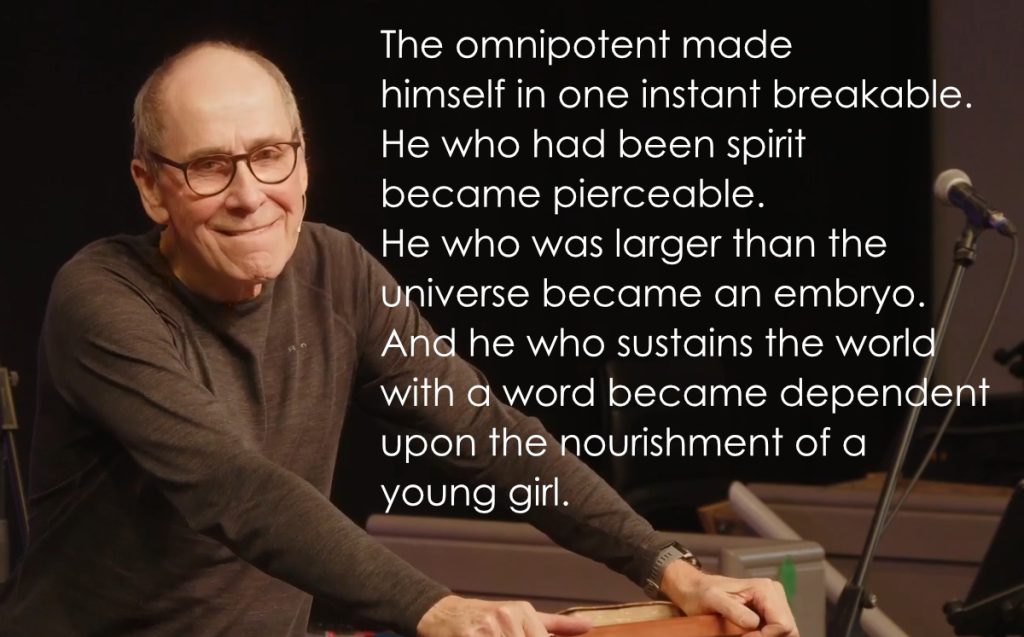
Consider this staggering reality: that newborn infant, totally dependent on a teenage mother for nourishment and care, was God incarnate. As one author beautifully expressed it: “The omnipotent made himself in one instant breakable. He who had been spirit became pierceable. He who was larger than the universe became an embryo.”
Mary held God in her arms.
Nothing Is Impossible with God
After explaining the miraculous nature of Mary’s conception, the angel Gabriel adds what almost seems like a postscript: “Even Elizabeth your relative is going to have a child in her old age, and she who was said to be unable to conceive is in her sixth month.”
Then comes the profound statement that echoes through millennia: “For nothing is impossible with God.”
This isn’t just a nice sentiment for greeting cards. It’s a fundamental truth about the character of God. The same God who brought life from an elderly, barren womb and from a virgin’s womb is the same God who works in our world today.
C.S. Lewis noted that miracles don’t break the laws of nature—they introduce something new that nature then takes over. When God creates life miraculously, that life still develops according to natural processes. Mary’s pregnancy lasted nine months. The baby grew, was born, and needed care like any other infant. The miracle was the initiation, not the entire process.
The God of Your Impossible Situation
What impossible situation are you facing today? Perhaps you’ve received a devastating medical diagnosis. Maybe a relationship seems beyond repair—with a spouse, a friend, a parent, or a child. Your financial situation might feel desperate. A loved one may be far from God, and years of prayers seem unanswered. Perhaps you’ve made mistakes that feel unforgivable.
The birth narratives remind us that God specializes in impossible situations. He brings life where there should be none. He makes ways where there are no ways. He transforms shame into glory, despair into hope, death into life.
Hebrews 11:6 tells us: “Without faith it is impossible to please God, because anyone who comes to him must believe that he exists and that he rewards those who earnestly seek him.”
Faith doesn’t mean having all the answers or understanding how God will work. Mary didn’t understand the biology of her conception. Joseph struggled with the shocking news. Elizabeth and Zechariah were stunned by their late-life pregnancy. But they all chose to trust the God for whom nothing is impossible.
An Invitation to Wonder and Worship
This Christmas season, let’s allow ourselves to be filled with fresh wonder at the incarnation. God didn’t send a representative or a messenger. He came himself, entering human existence at its most vulnerable point—as a helpless infant who needed his mother’s milk to survive.
Let that wonder draw you into deeper worship and greater devotion. Thank God for his indescribable gift—a gift that proclaims loudly that no situation in your life is beyond his power to redeem, restore, and resurrect.
The unbelievable truth is this: God is still the God of the impossible. And he invites you to bring your impossible situations to him in faith, believing that the same power that brought Jesus into the world can work miracles in your life today.
0 Comments