
We all love a good story, don’t we? From the sweeping romance of Les Misérables to the epic battles of The Lord of the Rings, something within us resonates with grand narratives that promise resolution, redemption, and hope. But what if I told you there’s a story bigger than all of these—one that not only promises a happy ending but invites you to step inside its pages and become part of it?
This is the story of the Bible. Not a circular tale that repeats endlessly, not a never-ending loop from which there’s no escape, but a purposeful narrative with a glorious conclusion. And here’s the remarkable part: this story has a place for you, not as a spectator but as an active participant.
The Human Longing for a Happy Ending
Deep within every human heart lies an unshakeable hope that things will get better. Even in the darkest circumstances—prisoners in concentration camps during World War II discovered this—those who survived were those who held onto hope. They believed in a future beyond their present suffering.
The author of Ecclesiastes tells us that God has “placed eternity in our hearts.” We weren’t designed to accept that this broken, beautiful, battered world is all there is. We know, somehow, that there must be something more.
And there is.
The Apostle John gives us a glimpse of this happy ending in Revelation: “Then I saw a new heaven and a new earth… God’s dwelling place is now among the people, and he will dwell with them… He will wipe away every tear from their eyes. There will be no more death or mourning or crying or pain, for the old order of things has passed away.”
This is the promise that anchors our hope—not wishful thinking, but a guaranteed future for those who align their lives with the Author of this grand story.
The Escalation of Sin
Yet we must acknowledge the tension in our current chapter. Ever since humanity’s first rebellion in the Garden of Eden, sin has spread like a swarm of bees—relentless, pervasive, suffocating. What began with one act of disobedience has multiplied into countless expressions of brokenness.
Consider how quickly things deteriorated in Genesis. First came the fracturing of the perfect harmony between man and woman. Then childbirth became painful. Work, which was meant to be fulfilling, became toilsome. The first murder followed. And on and on it went, until God Himself grieved that He had made mankind.
Why does sin continue to escalate? Three reasons stand out:
An absence of humility. The word “humility” comes from “humus”—earth. We are formed from dust, and every breath we take is a gift from God. Yet we forget our dependence on Him. Pride—the greatest sin of all, according to C.S. Lewis—tells us we don’t need God, that we can manage on our own. This is the sin of independence, and it’s the root of so much suffering in our world today.
An absence of honesty. Dishonesty has become trendy, even entertaining. We laugh at shows built on deception, but in real life, lies destroy. We get angry when leaders like politicians or corporate executives lie to us because we instinctively know that truth matters. Yet how often do we excuse our own sins, blaming our DNA, our upbringing, or our circumstances? First John reminds us: “If we claim to be without sin, we deceive ourselves and the truth is not in us.” True freedom comes only when we face the truth about ourselves.
An absence of love. Not sentimental, romantic love, but the kind of love that puts God first, others second, and ourselves last. This is how Jesus lived, and it’s what we’re called to as well. A French priest named Abbé Huvey wrote, “Our purpose in life is to love God as much as he loves you.” When we fail to do this, selfishness spreads, relationships become destructive, and we create cheap imitations of the real thing.
The Extravagance of Mercy
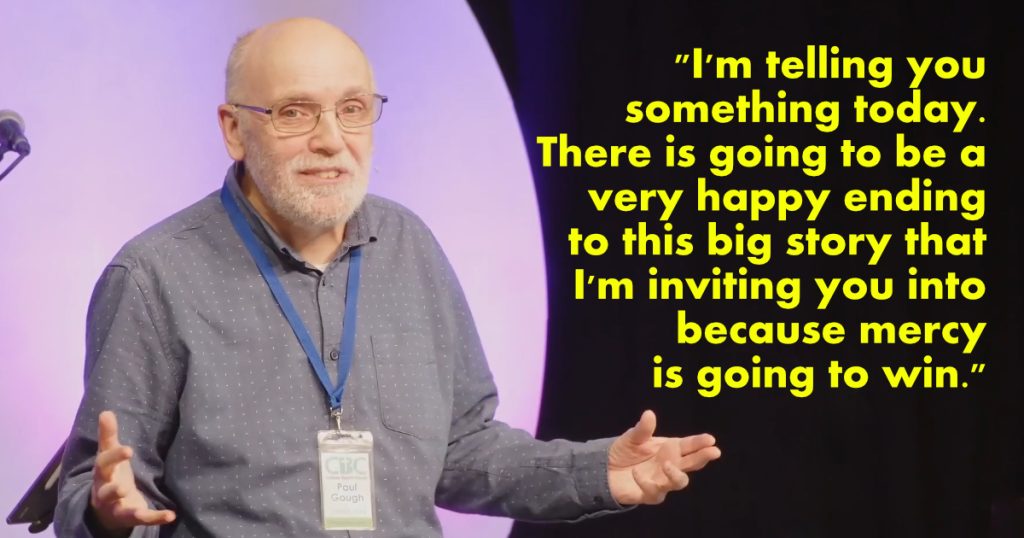
Here’s the breathtaking truth that changes everything: despite sin’s relentless advance, mercy is going to win.
Not might win. Not could win. Will win.
How can we be so certain? Three reasons:
Mercy is symbolized in the sign in the sky. After the flood, when God could have given up on humanity entirely, He made a covenant with Noah. The rainbow became His promise that He would never again destroy the earth. Every time you see a rainbow arcing across the sky, remember: it’s a symbol that mercy triumphs over judgment. A happy ending is coming.
Mercy is prophesied in the crushing of the serpent. In Genesis 3, God spoke to the serpent: “I will put enmity between you and the woman, and between your offspring and hers; he will crush your head, and you will strike his heel.” This is the first hint of the Messiah—Jesus, the new Adam, who would break the power of evil. But notice: in crushing the serpent’s head, He would be struck on the heel. Jesus absorbed all the poison of sin on the cross, taking the venom meant for us. The final battle has been fought and won through His death and resurrection.
Mercy is realized in eternity. In Revelation 4, John sees a vision of heaven where God sits on His throne, and surrounding that throne is a rainbow. The promise of mercy given to Noah finds its fulfillment in the new heaven and new earth. The story comes full circle, and the ending is glorious beyond imagination.
Stepping Into the Story
So what does this mean for us today? How do we respond to this epic narrative?
First, we must step into the story—not as casual readers but as committed participants. We declare that Jesus is Lord of our story, that we believe Him with all our hearts, and that we want to live for Him. When we do this, we begin to taste a little bit of heaven even now.
Second, we must look up with hope. Whatever worries, challenges, or concerns we face, we don’t walk through life with our eyes downcast. A happy ending is coming. As The Best Exotic Marigold Hotel puts it, “Everything will be all right in the end, and if it’s not all right, then it’s not the end.”
Third, we must get honest with God. Really honest. Are we hiding something? Pretending? Allowing pride to get in the way? Here’s the good news: when we confess, mercy and love await us. There is no condemnation for those who are in Christ Jesus—only grace and mercy.
Living in the Final Pages
Here’s something to consider: we are currently living in the final pages of this grand story. Ever since Jesus ascended into heaven, we’ve been in the last days. We don’t know how many pages remain, but we know the Author, and we know how it ends.
The best preparation for the conclusion is to fully enter the story now. To live each day in light of the happy ending that’s promised. To let hope anchor our souls when storms rage around us.
There’s hope—always hope—in this story. And that hope has a name: Jesus.
0 Comments