
In a world that often equates success with material wealth and self-sufficiency, there’s a profound spiritual truth that turns this notion on its head. It’s a paradox that challenges our understanding of true blessing and invites us to reconsider what it means to be truly rich.
Imagine standing at the bottom of a ladder. The first rung is within reach, but it requires you to acknowledge that you can’t climb on your own strength. This metaphor beautifully illustrates the concept of being “poor in spirit” – a state that, counterintuitively, opens the door to immense spiritual wealth.
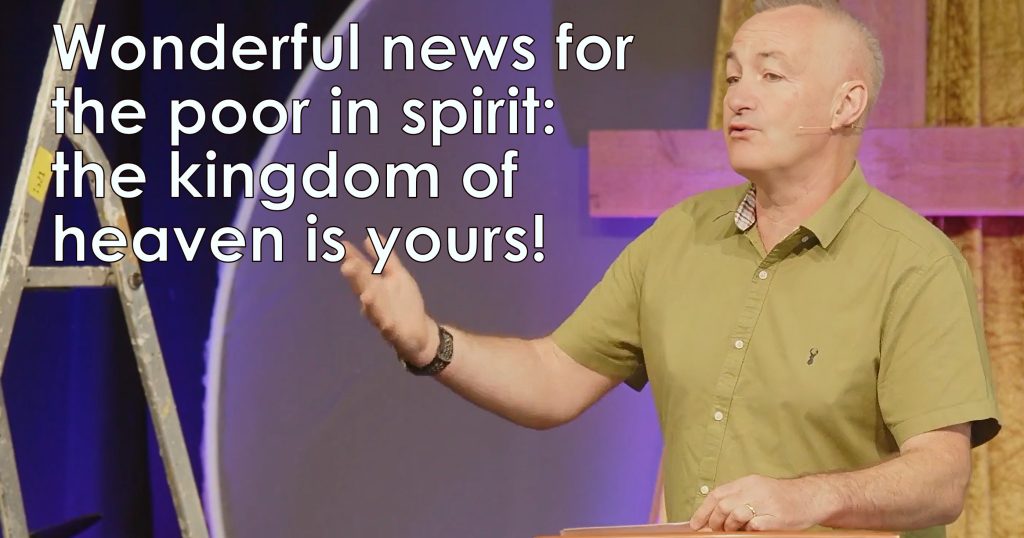
Jesus, in His revolutionary Sermon on the Mount, begins with a statement that must have shocked many of His listeners: “Wonderful news for the poor in spirit, for the kingdom of God is yours.” This declaration sets the foundation for a series of teachings that would reshape our understanding of blessedness and spiritual prosperity.
But what does it mean to be “poor in spirit,” and why is it so crucial to our spiritual journey?
Being poor in spirit is not about material poverty, though it certainly includes those who are physically poor. Rather, it’s a spiritual posture of humility and dependence on God. It’s recognizing our spiritual bankruptcy apart from divine grace. It’s coming before God with empty hands, acknowledging that we have nothing to offer Him that He hasn’t first given us.
This concept challenges our natural inclinations. We live in a culture that celebrates self-reliance, personal achievement, and individual strength. Yet, Jesus teaches that true blessedness begins with admitting our weakness and insufficiency.
Consider the Israelites standing before the Red Sea, with Pharaoh’s army closing in behind them. In that moment, they were utterly powerless, with nothing in their hands that could save them. It was precisely in that moment of recognized helplessness that God’s power was most magnificently displayed.
The apostle Paul, a man of great learning and accomplishment, came to understand this paradox deeply. He writes in 1 Corinthians, “I came to you in weakness with great fear and trembling. My message and my preaching were not with wise and persuasive words, but with a demonstration of the Spirit’s power.” Paul recognized that his own strength and wisdom were insufficient, and it was in that weakness that God’s power was made perfect.
This spiritual poverty is the foundation upon which all other spiritual growth is built. It’s the first rung of the ladder that leads to a deeper, richer relationship with God. Without this foundation, we cannot truly mourn our sin, become meek, hunger for righteousness, or show mercy to others. It’s the porch through which we must pass to access the vast mansion of God’s blessings.
But here’s the beautiful paradox: when we come to God with nothing, He gives us everything. When we admit our spiritual poverty, He offers us the riches of His kingdom. As Jesus said in Revelation, “You say, ‘I am rich; I have acquired wealth and do not need a thing.’ But you do not realize that you are wretched, pitiful, poor, blind and naked.” It’s only when we recognize our true state that we can receive the spiritual wealth God longs to give us.
This truth invites us to a radical honesty with ourselves and with God. It challenges us to lay aside our pretenses of self-sufficiency and to embrace our need for divine grace. It’s an invitation to vulnerability – with God, with ourselves, and with others.
In practical terms, this might mean:
- Approaching prayer not with a list of accomplishments, but with an honest acknowledgment of our needs and failures.
- Sharing our struggles with trusted friends or church community, rather than always presenting a facade of having it all together.
- Facing challenging tasks at work or home by first turning to God in humble dependence, rather than relying solely on our own abilities.
- Regularly reminding ourselves of our need for God’s grace, even (and especially) in areas where we feel competent.
The promise attached to this spiritual poverty is astounding: “for theirs is the kingdom of heaven.” This is not a future promise, but a present reality. Those who recognize their spiritual poverty gain immediate access to the richness of God’s kingdom – His rule, His power, His presence in their lives.
Jesus Himself modeled this humility. As Paul writes in Philippians, “Though he was God, he did not think of equality with God as something to cling to. Instead, he gave up his divine privileges; he took the humble position of a slave and was born as a human being.” The King of kings demonstrated the very poverty of spirit He calls us to embrace.
In embracing our spiritual poverty, we find ourselves in good company. Peter, the bold disciple, fell at Jesus’ feet declaring, “Go away from me, Lord; I am a sinful man!” It was from this place of recognized unworthiness that Peter was called into his world-changing ministry.
As we navigate a world that often measures worth by accomplishments, possessions, or influence, let’s remember that in God’s economy, the way up is down. The path to true riches begins with empty hands and a humble heart. It’s a journey that starts with a simple step – acknowledging our need and reaching out to the One who stands ready to fill us with His abundance.
So, let us approach God today not with our hands full of our own merits, but with empty hands ready to receive His grace. Let’s take that first step onto the ladder of spiritual growth, knowing that as we humble ourselves, He will lift us up. In our weakness, we will find His strength. In our poverty, we will discover the true riches of His kingdom.
This is the wonderful paradox of spiritual wealth – that in recognizing our poverty, we gain everything. It’s an invitation to a life of dependence on God, where our insufficiency meets His all-sufficiency, and where the kingdom of heaven becomes our present reality.
0 Comments