
1. Men’s Discussion Questions
- Playing Your Part: “We are living in Act 5, Scene 2 of God’s great story. We are not spectators sitting in the audience—we are the cast, and the Holy Spirit is the director.” Where in your week—at work, at home, or with mates—do you find yourself slipping into spectator mode rather than actively stepping onto the stage?
- Guarding Your Script: In Romans 12, Paul urges us not to be squeezed into the mould of the surrounding world. What are the biggest cultural pressures or “scripts” competing for your headspace right now, and how can you practise “picky thinking” to filter them out?
- Spotting UFOs: When an untruth leads to a false narrative and an overreaction, it can derail your week. What is a common lie or false narrative you tend to believe under pressure, and what specific promise from Scripture can you replant in its place?
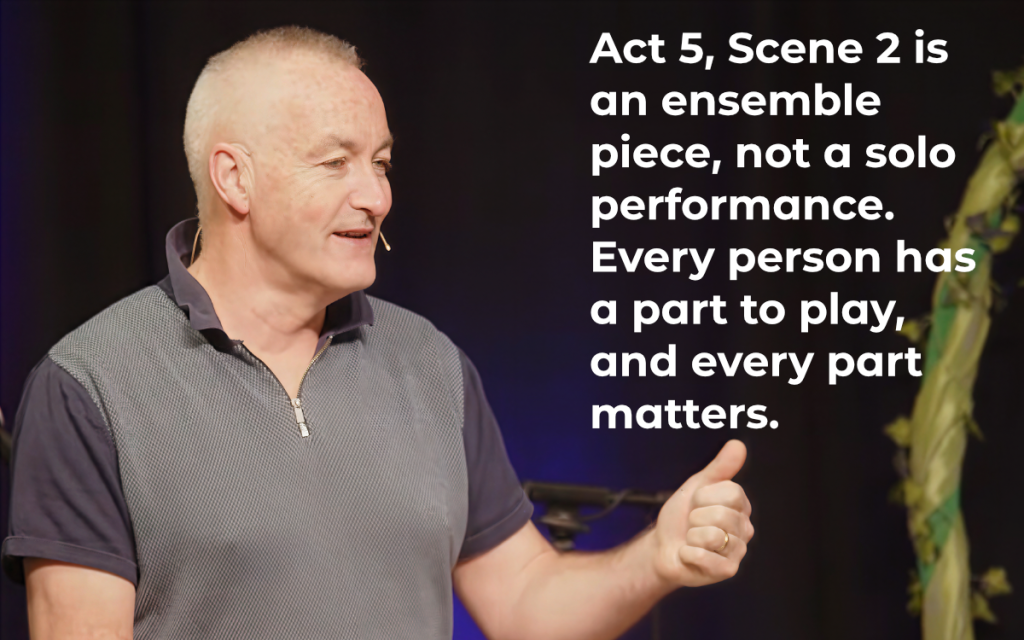
- Brotherhood on the Stage: “Act 5, Scene 2 is an ensemble piece, not a solo performance. Every person has a part to play, and every part matters.” Who are the men in your life who can whisper your lines when you forget them or steady you when you have stage fright, and how can you build stronger camaraderie around a table or in a group?
- Leaving the Green Room: “The green room is comfortable—it has tea, biscuits, and good company—but it is not where we are designed to stay. God wants us out in the world bringing hope and grace.” What is your personal “green room,” and what is one practical step you can take this week to deploy your God-given gifts among people who don’t yet know Jesus?
2. Women’s Discussion Questions
- Living the Unfinished Story: “We are living in Act 5, Scene 2 of God’s great story. We are not spectators sitting in the audience—we are the cast, and the Holy Spirit is the director.” How does viewing your everyday routines, conversations, and responsibilities as part of God’s unfolding story bring fresh purpose to your week?
- Uprooting & Replanting: When unhelpful or fearful thoughts take hold, we are invited to ask God to uproot them and replant His truth. What untruths or negative narratives do you find hardest to let go of, and how can soaking in God’s Word help reshape your thinking?
- Walking Together: “Act 5, Scene 2 is an ensemble piece, not a solo performance. Every person has a part to play, and every part matters.” Have you ever been tempted to slip into the audience thinking your contribution isn’t needed, or felt exhausted trying to carry everything alone? How can we better spur one another on beyond simply sitting in rows on a Sunday?
- Grace Gifts in Action: Spiritual gifts (charismata) are unearned expressions of God’s grace meant to move the plot forward. Which practical gifts—such as hospitality, encouragement, serving, or showing mercy—do you sense God nudging you to put into action right now?
- Declaring Victory: “Act 6 is already written and God wins. We are not serving to try and secure victory; we are serving to declare a victory that has already been won.” How does knowing the final outcome of the story lift the pressure off your shoulders and give you boldness to share Jesus’ love in your community?
3. General Discussion Questions
The sermon describes Christians as being in ‘Act 5, Scene 2′ of God’s story, between the coming of the Spirit and Jesus’ return — how does understanding your life as part of an ongoing, unfinished story change the way you approach your daily decisions and responsibilities?
Paul in Acts 28 ends his ministry narrative not with a dramatic conclusion but with two quiet years of faithful proclamation — what does this suggest about how God measures faithfulness, and how does it challenge our culture’s obsession with visible results?
Romans 12 calls believers to be transformed by the renewing of their minds rather than being conformed to the world — in what specific areas of your thinking do you feel the greatest pressure to simply follow the script that culture hands you?
Max Lucado’s concept of ‘picky thinking’ draws from 2 Corinthians 10, which describes taking every thought captive and making it obey Christ — what does this discipline look like practically in your daily life, and where do you find it most difficult to apply?
The UFO framework identifies how an untruth can lead to a false narrative and then an overreaction — can you identify a recurring untruth the enemy uses against you, and what specific truth from Scripture could you use to counter it?
The sermon emphasises that Act 5, Scene 2 is an ensemble piece rather than a solo performance — in what ways might you be either trying to carry too much alone, or alternatively withdrawing from the stage and leaving your part unplayed?
Hebrews 10 warns against meeting out of mere habit and instead calls believers to spur one another on — what would it look like for your relationships within the church to move from passive coexistence to genuinely encouraging one another toward faithfulness?
Paul describes spiritual gifts using the Greek word charismata, rooted in charis meaning grace, emphasising they are unearned and undeserved — how does understanding your gifts as expressions of grace rather than personal achievement change the way you use them or feel about them?
The sermon uses the image of the green room as a comfortable but ultimately wrong place to remain — what is your personal ‘green room,’ the comfortable space that keeps you from stepping out to serve and share Jesus with those around you?
The sermon closes with the reminder that Act 6 is already written and God’s victory is certain — how does knowing the outcome of the story free you from fear and motivate you to declare that victory in the places and relationships God has placed you in?
0 Comments