
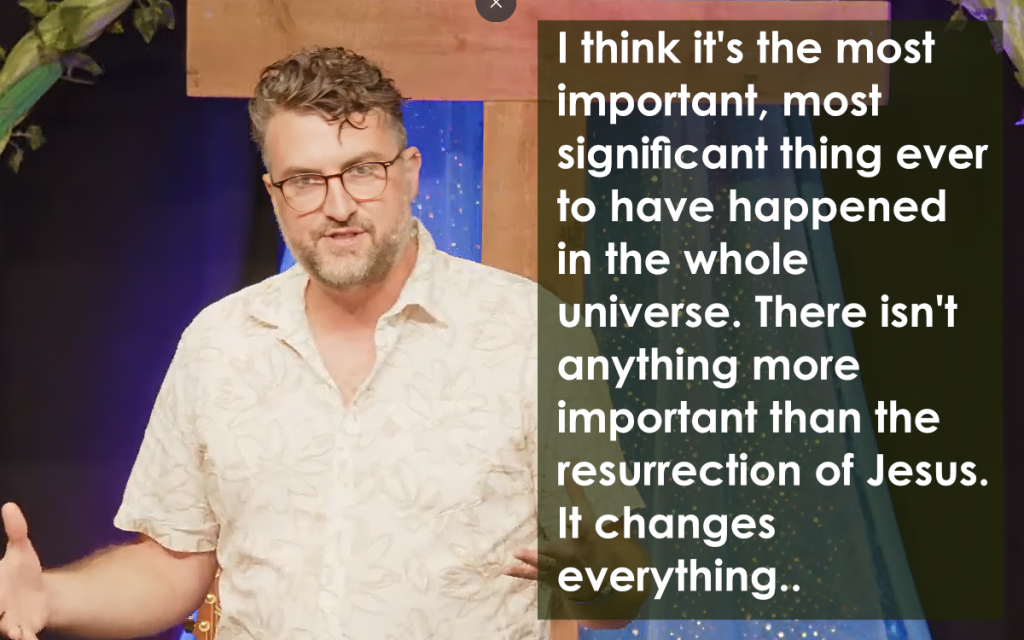
What if everything you thought you knew about defeat and victory was completely upside down? What if the moment that looked like the ultimate failure was actually the ultimate triumph? The resurrection of Jesus Christ is not simply a religious story for Christians to celebrate once a year. It is, arguably, the most significant event ever to have taken place in the entire history of the universe. And if that sounds like an overstatement, consider what it actually means, and what it changes.
A Death That Was Real
Before we can talk about the resurrection, we have to be honest about the death. Jesus did not simply faint on the cross. He did not slip into a coma and recover. The Romans were professionals when it came to execution, and they knew a dead man when they saw one. The soldiers broke the legs of the two criminals crucified alongside Jesus to hasten their deaths, but when they came to Jesus, they saw he was already gone. To be certain, they drove a spear into his side. The outflow of blood and water that followed was a physiological confirmation that the body had ceased to function. Jesus was completely, undeniably dead.
This matters because the resurrection is not a story about a near-death experience. It is a story about a man who was on the other side of death, fully and completely, who then came back through it. That is the claim. That is what changes everything.
Four Things the Empty Tomb Tells Us
John chapter 20 gives us a vivid, detailed account of the resurrection and its immediate aftermath. Within that chapter, four remarkable truths emerge.
Death is defeated. Jesus did not merely survive death. He conquered it. He walked into the darkness of the grave and walked back out, and in doing so he dismantled death’s claim to have the final word. As the apostle Paul writes in 1 Corinthians 15, God gives us victory over sin and death through our Lord Jesus Christ. And in Ephesians 1, we are told that the very same power that raised Christ from the dead is available to those who believe. Death may still come for each of us, but it no longer gets to win.
An unlikely witness sees him first. Mary Magdalene arrives at the tomb while it is still dark. She is grief-stricken, red-eyed, barely able to see straight. When she encounters the risen Jesus, she mistakes him for the gardener until he speaks her name. In that single word, she knows him instantly. She runs to tell the others: “I have seen the Lord.”
What is striking here is who Jesus chose to appear to first. In the culture of first-century Judea, a woman’s testimony carried half the legal weight of a man’s. If someone were fabricating this story, they would never have chosen a woman as the primary witness. And not just any woman, but one who, as Luke chapter 8 tells us, had been freed from seven evil spirits. Her past was complicated. Her reputation was not pristine. And yet Jesus reveals himself to her before anyone else. The message is clear: labels do not limit what God can do with a person. He knows your name, and he is not put off by your history.
Locked doors are no barrier. On the evening of the resurrection, the disciples are huddled together behind locked doors. They are terrified. Every other would-be messiah in that era had been captured and executed by the Romans, and the pattern was always the same: once the leader was gone, the followers were next. So they hide.
And then Jesus simply appears among them. No fanfare. No forced entry. He stands in their midst and says, “Peace be with you.” He shows them his hands and his side. And these terrified, hiding men are transformed. Fear gives way to joy. Paralysis gives way to purpose. He breathes the Holy Spirit into them and sends them out into the world on a mission that is still unfolding today.
Bishop Lesslie Newbigin captured something important here: the resurrection was not the reversal of a defeat, but the manifestation of a victory. It was never plan B. It was always the plan. What looked like catastrophe from behind locked doors was, in fact, the moment everything changed.
Doubt is not disqualifying. Thomas was not in the room that evening. When the others told him what had happened, he refused to believe without physical proof. He wanted to see the nail marks. He wanted to touch the wounds. He is famously remembered as “Doubting Thomas,” and perhaps some of us recognize ourselves in him.
A week later, Jesus appears again. And he goes straight to Thomas. He does not scold him from a distance. He does not write him off. He says, “Put your finger here. See my hands. Reach out your hand and put it into my side. Stop doubting and believe.” He invites Thomas into closeness, into contact, into intimacy. And Thomas responds with one of the most profound declarations in all of scripture: “My Lord and my God.”
Jesus is not offended by doubt. He meets the doubter with compassion and draws him closer, not further away. If you are someone who is wrestling with questions, who is not sure what you believe, the response of Jesus is not to wait until you have everything figured out. It is to seek him, to lean in, to reach out.
Broken Things Made Beautiful
There is a Japanese art form called kintsugi, in which broken pottery is repaired using gold. The cracks do not disappear. They are filled, made visible, made beautiful. The brokenness becomes part of the story, and the gold running through the fractures is what makes the piece extraordinary.
This is a picture of what the resurrection offers. Jesus meets the grief-stricken where they weep. He meets the fearful where they hide. He meets the doubting where they question. And he does not simply patch things over. He restores, transforms, and fills the broken places with something that could not have been there before.
The gospel of John tells us that these things were written so that you might believe that Jesus is the Messiah, the Son of God, and that by believing, you may have life in his name.
That life is being offered still. The question is simply whether you will reach out and take it.
0 Comments