
There’s something remarkable about hurricanes. At their center, surrounded by walls of violent, turbulent winds capable of destroying everything in their path, lies the eye—a region of complete calm. This meteorological phenomenon offers us a powerful picture of what biblical peace can look like in our lives.
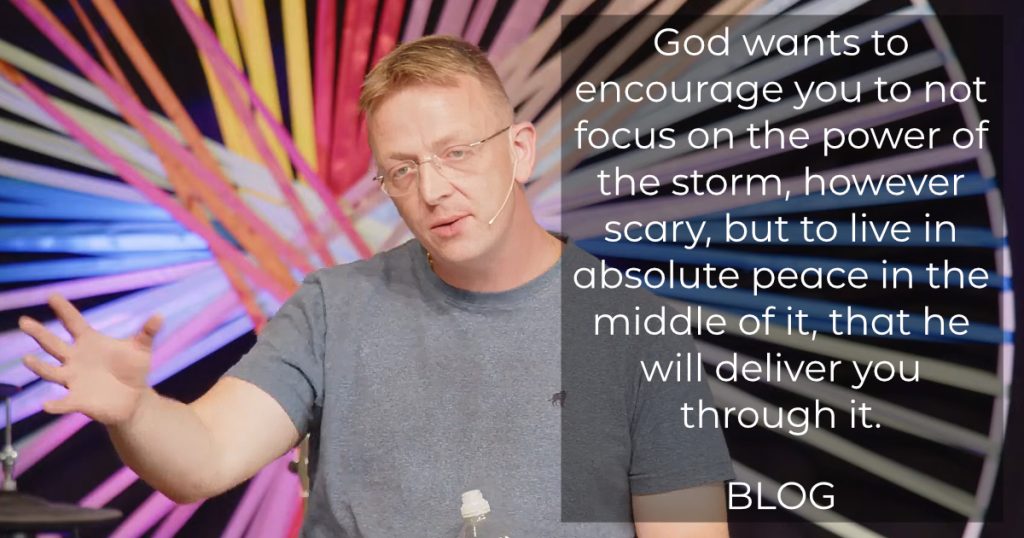
When used to describe human experience, “the eye of the storm” refers to a state of being at the center of chaotic or turbulent circumstances while maintaining inner calm. It’s not about the absence of difficulty, but about finding peace in the midst of it.
We all make plans. We pray for things to go well, for life to proceed smoothly. But inevitably, storms arrive. The question isn’t whether they’ll come, but how we’ll respond when they do.
Three Men, One Impossible Choice
The story of Shadrach, Meshach, and Abednego in Daniel chapter 3 gives us one of Scripture’s most powerful examples of peace under pressure. These three Jewish men were living in exile in Babylon under King Nebuchadnezzar—a ruler who, to put it mildly, was somewhat unhinged.
Nebuchadnezzar had erected a massive golden statue and commanded everyone to bow down and worship it when they heard the sound of musical instruments. The penalty for disobedience? Being thrown into a blazing furnace.
When the king discovered that these three men refused to bow, he was furious. He summoned them and gave them one final chance: worship the statue or face the fire.
Their response is breathtaking:
“O Nebuchadnezzar, we do not need to defend ourselves before you in this matter. If we are thrown into the blazing furnace, the God that we serve is able to save us from it. He is able to save us from it and he will rescue us from your hand. But even if he does not, we want you to know, O King, that we will not serve your gods or worship the image of gold that you have set up.”
These verses are biblical peace in action. They reveal something profound about the nature of faith-filled peace.
Peace Is a Choice, Not Just a Feeling
God absolutely grants peace. Scripture promises this repeatedly. Isaiah 26:3 tells us, “You will keep in perfect peace those whose minds are steadfast because they trust in you.” Jesus himself said, “Peace I leave with you, my peace I give you. Not as the world gives do I give you. Let not your hearts be troubled, neither let them be afraid” (John 14:27).
But here’s the crucial insight: while God grants the peace, we have a role in it. We have a choice.
Biblical peace isn’t just a warm, fuzzy feeling that occasionally washes over us during difficult times. It’s a state of being that we can nurture and develop through our daily relationship with Jesus. Those Holy Spirit moments of supernatural calm are absolutely real and God-given, but peace runs deeper than sporadic feelings.
How do we cultivate this state of being? It stems from our intimacy with Jesus. Our responses in the big storms are likely to be shaped by the decisions we make in the absence of storms—our day-to-day walk with God.
Consider these questions:
- Is Jesus truly number one each day?
- Are we giving Him time in our day?
- How is our prayer life—is it consistent, disciplined, honest?
- Are we taking time to listen to the voice of the Holy Spirit?
Biblical peace is actually the result of thousands of little choices we make, perhaps every single day. And those choices carry weight. The more we choose God as number one, the more this state of being develops.
The World’s False Promises
Shadrach, Meshach, and Abednego could have chosen differently. They could have bowed to the statue and spared themselves the incoming storm. The world and the enemy constantly offer us alternative paths that seemingly promise peace:
“If I could just get one more zero in my bank account, then everything will be peaceful.” “If I could just get that job, that house, that relationship…”
But these three men chose to trust in the most extreme, life-threatening situation imaginable. They chose faith in the face of adversity. Verse 17 is peace in action—a result of faith.
Jesus in the Fire
The king, true to his word, had the furnace heated seven times hotter than usual. So intense was the heat that the soldiers who threw the three men into the flames died from the exposure. But then something extraordinary happened.
Nebuchadnezzar leaped to his feet in amazement. “Weren’t there three men we threw into the fire?” he asked. His advisors confirmed. “But I see four men walking around in the fire, unbound and unharmed. And the fourth looks like a son of the gods.”
Who was the fourth man in the fire? Jesus.
When all those little choices of faith add up, when storms come along, we can choose to have faith that Jesus is in the storm with us. This is profoundly important because sometimes it doesn’t feel like He’s there. When difficulties come and we feel squeezed and pressed with seemingly no way out, we need to remember: Jesus is with you in the storm.
The Miracle Worker and the “But Even If”
Verse 17 opens a doorway to an unshakable belief that we walk with a miracle-working God who can deliver us from any storm this side of heaven. We should pray boldly to that miracle worker. Pray fervently for His power, His healing, His protection over our physical bodies. Pray for renewal of mind, for circumstances in our financial, married, family, and work lives. Keep asking, keep seeking, keep knocking.
God is still the miracle-working God. He hasn’t changed.
But we must also be wise and vigilant, because verse 18 presents a challenging reality: “But even if he does not…”
Even if God doesn’t deliver us from the furnace, even if He doesn’t rescue us from the king’s hand—we still trust Him.
This is a difficult statement to comprehend. Does our peace and faith in the Lord have a cut-off point? Does it have boundaries that, if God doesn’t deliver us the way we hope this side of heaven, our peace evaporates?
The Deepest Peace
Among us are countless storms: physical ailments, bodies that hurt, incurable sickness affecting us or our loved ones, minds that feel dark and trapped, financial circumstances that seem crippling, marriage problems, and more.
What if some of those things are not fully restored this side of heaven? Is there still peace to be had in that storm?
Absolutely—though it’s difficult.
Consider Jesus on the donkey, riding into Jerusalem. He knew what was coming. He knew there would be no miraculous deliverance for His body. In fact, He knew His body would be broken. In the Garden of Gethsemane, He knew His mind was troubled and that His friends would abandon, deny, and betray Him.
This side of glory, there would be no full renewal for His mind or protection for His body. But His spirit—His soul—was being commended to the Father. He had a state of being of peace because He knew what was written. Glory was coming.
Not “glory was coming.” Glory IS coming.
Persevere to the Crown
We may arrive at the small gate Jesus spoke of having walked that narrow road with bodies that are battered and broken, with minds that are not fully renewed. But we can have hope and peace in the deepest part of our spirit.
Because on arrival there, there is a crown the Lord has promised for persevering. There is a room in the Father’s house. There will be a new body. And your soul, your spirit—that’s already in God’s hands. He promises that no one will ever take that from Him. No evil, no circumstance, no illness.
You’re His, and you always will be.
No matter how big the storms, no matter how weary we become, persevere. The Lord will deliver you—if not from the fire, then through it, and ultimately into glory.
That is peace in the storm.
0 Comments