
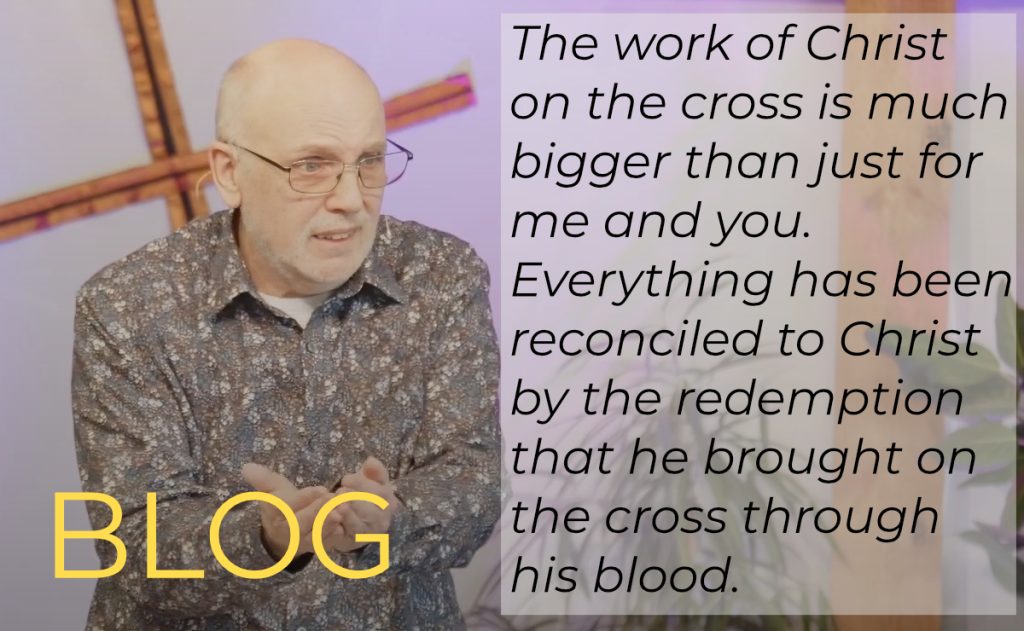
When we look at the cross, we often see it through a deeply personal lens. We think about our forgiveness, our salvation, our transformation. And rightly so—these are precious truths that anchor our faith. But what if the work accomplished on that wooden beam extends far beyond our individual stories? What if the cross represents something so vast, so comprehensive, that it encompasses literally everything?
The Power of One Word: Everything
In Colossians 1:15-20, we encounter a stunning portrait of Jesus Christ that challenges us to expand our understanding of what happened on Calvary. The passage repeats one word with remarkable emphasis: everything. Not just some things. Not just spiritual things. Not just people. Everything.
“All things were created in Him. He created everything in heaven and on earth. He created everything that can be seen and everything that can’t be seen.”
This isn’t poetry for poetry’s sake. This is a declaration that the scope of Christ’s redemptive work matches the scope of His creative work. The One who made all things came to reconcile all things.
Consider the implications. When we look at our fractured world—wars raging across continents, families torn apart by conflict, creation groaning under environmental strain, political systems in turmoil—we can easily despair. Where is the hope? Where is the resolution?
The answer stands on a hill outside Jerusalem, arms outstretched on a cross.
More Than a Personal Savior
Western Christianity has sometimes reduced the gospel to an individualistic transaction: Jesus died for my sins so I can go to heaven when I die. While this contains truth, it’s like describing the ocean by examining a single drop of water. You’ve identified something real, but you’ve missed the magnitude.
The cross wasn’t futile. It wasn’t pointless. It wasn’t merely about securing individual salvation, as glorious as that is. Through “one act of pure, perfect, holy, sacrificial love, Jesus was reconciling all things to himself.”
Think about Nigeria. Think about North Korea. Think about the ice caps melting and the climate changing. Think about the brokenness in your neighborhood, the dysfunction in local businesses, the pain in schools and hospitals. Everything—every square inch of creation, every relationship, every system, every molecule—falls under the reconciling work of Christ.
This doesn’t mean everyone will be saved regardless of their response to Jesus. Scripture is clear that belief matters, that our response to Christ determines our eternal destiny. But it does mean that nothing lies outside the scope of Christ’s redemptive intention and power.
The Qualified Redeemer
How can one person possibly accomplish such a cosmic task? Can we trust that this reconciliation is real and not wishful thinking?
Paul answers by giving Jesus two crucial titles in Colossians 1:15.
First, Jesus is “the image of the invisible God.” The Greek word used here isn’t “homoios,” which means “similar to” or “resembling.” Paul uses “eikon”—icon—meaning an exact representation, like a reflection in a mirror or an image on a coin. When you want to know what King Charles looks like, you examine a stamp bearing his image. When you want to know what God is like, you look at Jesus.
Jesus isn’t God-like. Jesus is God. He is “the exact representation of His being,” as Hebrews declares. The invisible has become visible. The unknowable has become known. “Anyone who has seen me has seen the Father,” Jesus said.
This is why we can trust His work on the cross. The One reconciling all things to Himself is the very image of God—fully divine, fully qualified, fully capable.
Second, Jesus is “the firstborn over all creation.” This doesn’t mean He was the first thing created, as though He came into existence at some point. To ancient Jewish ears, “firstborn” was a messianic title. It signified supremacy, preeminence, and authority. God Himself was described as “firstborn of the world”—not because He was born, but because He existed before all things and holds authority over all things.
Jesus shares this title. He was before all things. Through Him, all things were created. And now, through His death and resurrection, all things are being reconciled back to Him.
Restoring Original Harmony
The flood narrative in Genesis includes a beautiful promise: God vows never to destroy the earth again, establishing an everlasting covenant “between God and all living creatures of every kind on the earth.” The whole of creation has always been precious to God.
Through the cross, Jesus is “restoring the harmony of the original creation, resolving the disharmonies of nature and the inhumanities of humankind.” He’s bringing creation back to what it was always meant to be—a place where God’s glory is reflected, where shalom reigns, where all things exist in right relationship with their Creator.
This is good news not just for souls but for soil. Not just for heaven but for earth. Not just for the spiritual realm but for the physical world we inhabit.
Living in Light of Cosmic Reconciliation
How should we respond to this magnificent truth?
With Praise. Like Paul, who uses what was likely an early church hymn in this passage, we should lift our eyes and give praise to the One who holds the world in His hands. Even in troubling times—especially in troubling times—we can worship the Christ who has reconciled all things.
With Peace. If Jesus has reconciled everything to Himself, including your situation, your illness, your troubles, then you can rest. He’s got you. The risen Christ who conquered death holds your life in His care. Receive His peace. And wherever you go, be a person of peace. Imitate the reconciling heart of Jesus in your relationships and interactions.
With Participation. If the cross wasn’t just about us but about all things, then we’re invited into God’s reconciling work. Share God’s love wherever you can. Listen to people. Care for them. Think the best of them. Be agents of restoration in a broken world.
Why doesn’t God simply obliterate all evil right now? Because God’s way has always been the way of love. And love wants everyone possible to come to know Him. That’s why He’s patient. That’s why He waits. That’s why He invites us to participate in His mission of reconciliation.
The Cosmic Love Story
What was Jesus doing on the cross? He was engaging in cosmic love. The Creator of the cosmos came to save the cosmos, and He was the only One qualified to do so.
This Easter, as we celebrate the resurrection, let’s remember that we’re celebrating more than personal salvation. We’re celebrating the victory of love over hatred, life over death, reconciliation over alienation—not just for ourselves, but for everything.
The cross stands as the ultimate declaration that nothing—absolutely nothing—is beyond the reach of God’s redeeming love.
0 Comments