
When we hear the word “boundaries,” our first reaction might be resistance. Boundaries feel restrictive, confining, like barriers preventing us from experiencing true freedom. But what if boundaries are actually the very thing that makes freedom possible?
Picture a construction site with caution tape marking safe zones. On one side of the tape, children play freely with toys, building and creating without fear. On the other side, cement mixers spin, cars race past, and deep holes are being dug. The tape isn’t there to steal joy—it’s there to protect it. The children aren’t focused on the boundary at all; they’re simply enjoying the safety it provides.
This is the heart of what God offers us through His commandments.
The Gift of the Ten Commandments
In Exodus 20, God delivers the Ten Commandments to the Israelites—a people freshly liberated from slavery in Egypt. After experiencing miraculous freedom from Pharaoh’s oppression, they might have expected unlimited autonomy. Instead, God gives them laws. Rules. Boundaries.
At first glance, this seems contradictory. Why would a God who just set people free immediately give them restrictions? But these commandments weren’t chains—they were guardrails on the path to flourishing life.
The commands cover every aspect of human existence: who we worship, how we work, how we treat others, what we desire, and how we rest. They’re not arbitrary rules from a controlling deity, but wisdom from a loving Father who knows exactly what His children need to thrive.
As Proverbs 8 declares, God’s law is more precious than rubies. Psalm 119 goes even further, saying His laws are sweeter than honey. These aren’t the words of oppressed people longing for freedom—they’re the testimony of those who’ve discovered that true freedom exists within God’s design.
The Danger of Walking the Edge
Here’s an uncomfortable question: Where do we position ourselves in relation to God’s boundaries?
Imagine standing on a stage where the edges represent God’s commands against murder, stealing, adultery, and idolatry. Technically, you could walk right up to the edge, lean over, and still claim you’re within bounds. You haven’t crossed the line, after all.
But is that wisdom? Is that safety?
Consider a coach driver navigating a mountain road with half the tire hanging over the cliff’s edge. Technically safe, perhaps, but would any passenger feel comfortable? We’d all prefer the driver stay well away from the edge.
Yet in our spiritual lives, we sometimes play this dangerous game. “I’m not actually murdering anyone—I just hate them a little.” “I’m not stealing—I’m just taking what I deserve.” “I’m not worshiping idols—I just prioritize everything else above God.”
Jesus addressed this edge-walking mentality directly, explaining that the spirit behind the commandments matters as much as the letter. Hatred is murder of the heart. Lust is adultery in intention. The boundaries aren’t just external lines to avoid crossing—they’re invitations to a transformed heart.
The Freedom to Rest
One of the most countercultural commandments is the call to Sabbath rest. Imagine being asked to become a machine—moving your arms continuously, making repetitive sounds, working without ceasing. How long could you maintain that pace?
We’re not machines. We’re not designed for endless productivity without rest. Yet modern culture pushes us relentlessly toward that very existence, measuring our worth by our output.
The Israelites knew this reality intimately. For years in Egypt, they were human machines, making bricks with no rest, valued only for their productivity. When God commanded Sabbath rest, He was making a revolutionary statement: Your worth isn’t determined by your output.
Two truths we desperately need to embrace:
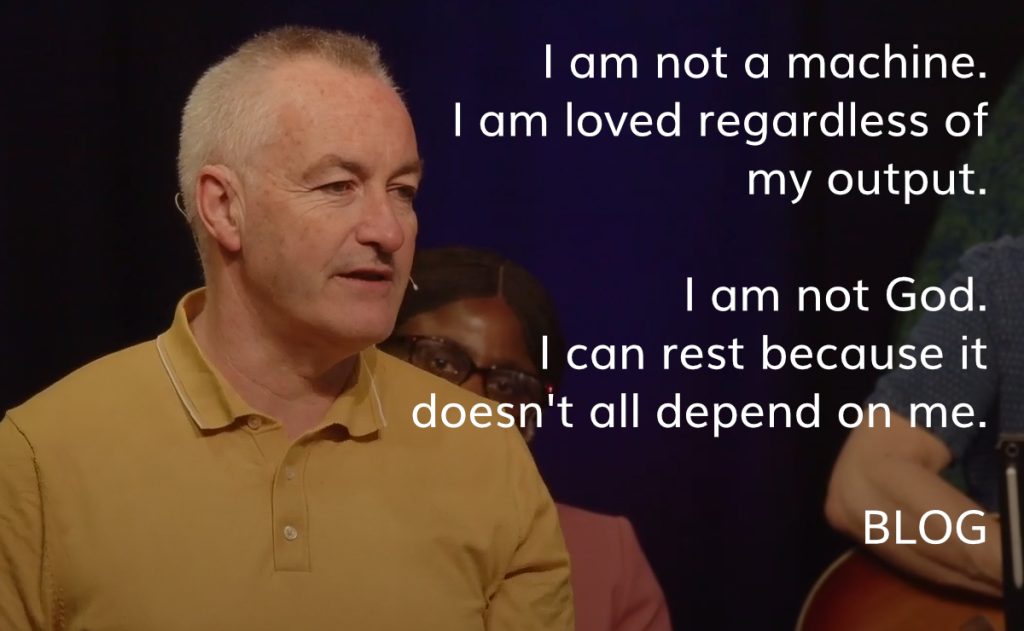
I am not a machine. I am loved regardless of my output.
I am not God. I can rest because it doesn’t all depend on me.
These statements challenge the core lies of our achievement-oriented culture. We are loved not because of what we produce, but because of whose we are. And the world doesn’t depend on our constant striving—we have a Savior who’s already done the work.
Loving God, Loving Others
Jesus summarized the commandments beautifully: Love the Lord your God with all your heart, mind, and soul, and love others as yourself. Every commandment flows from these two loves.
The commands about how we treat one another—not murdering, not stealing, not bearing false witness, not coveting—all stem from a heart that genuinely desires the best for others. They protect relationships and build communities where people can flourish together.
In our interconnected world, these ancient commands remain profoundly relevant. Children face unprecedented dangers through social media. Elderly people experience isolation as families spread across continents. Vulnerable people need advocates and friends. Poor families around the world need support and hope.
God’s heart beats for all these people, and His commands guide us toward lives of meaningful service and genuine love.
The Battle Against Coveting
Perhaps the most challenging commandment for our generation is the final one: Do not covet. In a world of endless advertising and curated social media feeds, we’re constantly bombarded with images of what we don’t have.
We see airbrushed photos, AI-generated perfection, and highlight reels of others’ lives. Comparison becomes our default mode, and with it comes anxiety, depression, and self-loathing.
The antidote? Gratitude.
When we cultivate thankfulness for what God has given us, we find contentment that advertising cannot steal and social media cannot diminish. A helpful practice: Thank God for three things every night before bed. Consider this challenging question: If you only had tomorrow what you thanked God for today, what would your life look like?
Under New Management
Imagine walking into a store with a sign reading “Under New Management.” You ask the employee how things are going. “Fantastic!” she replies. “The old boss was terrible. But the new one really cares—not just about profit, but about people.”
This is the story of Exodus, and it’s our story too. Freed from Pharaoh, the Israelites became bound to God. And what seemed like trading one master for another was actually the difference between slavery and sonship.
Since putting our trust in Jesus, we’ve experienced this same reality. Our new Manager really cares about people. His boundaries aren’t about control—they’re about love. His commands aren’t burdens—they’re the path to the abundant life He promises.
God is like a great lion—not safe in the domesticated sense, but powerfully, wonderfully good. His laws are the fence that keeps us from danger. We are not machines built for endless work. We can take off the heavy yoke of comparison and greed and put on the light gift of His grace.
Today, we live under new ownership. All our lives belong to Him. And in that belonging, we find the freedom we’ve been searching for all along.
0 Comments