
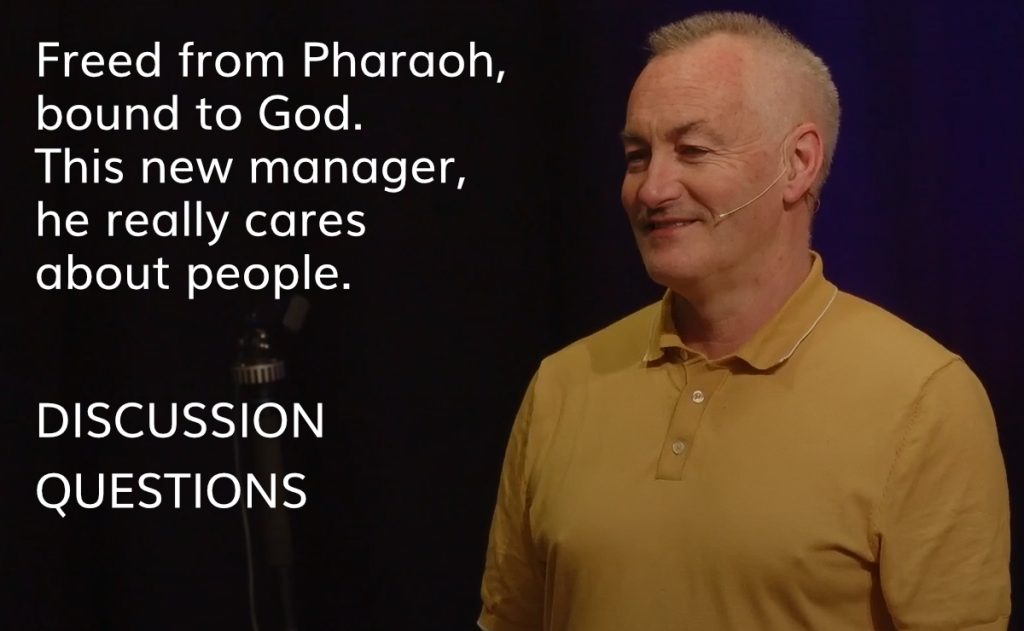
Here are some simple, family‑friendly discussion starters based on the sermon. You can pick just a few for one mealtime rather than trying to do them all at once. At the bottom of the page are other questions!
1. Boundaries & Freedom
- In the sermon, the kids played inside the taped “boundary.”
- Why were they actually safer and freer inside the boundary than outside it?
- Can you think of any real‑life examples where rules actually help you enjoy something more (e.g., road rules, game rules, school rules)?
- Imagine the edge of a cliff or a very steep hill with a path and a fence.
- Where would you feel happiest playing: right next to the edge, or safely back from it? Why?
- How is that like staying far away from the edge of sin (not just “as close as I can get without actually doing it”)?
- The Israelites had just been set free from slavery, and then God gave them the Ten Commandments.
- Why do you think God gave rules to people he had just set free?
- Do you ever feel like God’s rules are “spoiling your fun”? What might God see that you don’t?
2. God’s Character: Not Safe, But Good
- The sermon quoted The Lion, the Witch and the Wardrobe: “Of course he isn’t safe. But he’s good.”
- What do you think that means about God?
- Do you find that idea comforting, scary, or both?
- If you had to walk through a dangerous jungle, would you rather:
- Go alone, or
- Ride on the back of a fierce, powerful lion who is on your side?
Why? How is that like living life with God?
3. The Ten Commandments & Everyday Life
- The Ten Commandments were described as “boundaries so that we can flourish.”
- Which of the commandments feel easiest to understand?
- Which feel hardest or most challenging for you, and why?
- Jesus summed up God’s commands as:
- “Love the Lord your God with all your heart, mind, soul, and strength” and
- “Love your neighbour as yourself.”
- How could we show love for God and for others this week in one small, practical way?
4. Sabbath & Rest: “I Am Not a Machine”
- Everyone pretended to be a beeping, bopping machine—and then stopped.
- Do you ever feel like life is just “go, go, go” (school, work, activities, screens)?
- What are some signs that you personally need a rest?
- The sermon line said: “I am not a machine. I am loved regardless of my output.”
- What does “output” mean in your life (grades, work, chores, achievements, likes online)?
- Does it feel true that you are loved even if you do nothing impressive today?
- Another line said: “I am not God. I can rest because it doesn’t all depend on me.”
- Are there things you worry about because you feel like it does depend on you?
- How could trusting God more help you rest and worry less?
- What could “Sabbath rest” look like for our family?
- If we picked a special time to rest, enjoy God, and enjoy each other, what would you want to include? What would you want to leave out?
5. Relationships & Treating Others Well
- Many of the commandments are about how we treat other people (don’t murder, don’t steal, don’t lie, don’t commit adultery).
- How do those kinds of rules help protect relationships?
- Which of those do you see people breaking often in our world (even in “small” ways)?
- The sermon mentioned four groups:
- Children
- Older people
- People who have had it tough
- Poor families in other countries
- Which of these groups do you feel most drawn to care about, and why?
- What is one simple thing our family could do in the next month to care for one of those groups (prayer, giving, visiting, writing, volunteering, etc.)?
6. Contentment & “Do Not Covet”
- The last commandment is “Do not covet”—don’t desire what belongs to someone else.
- What are some things people our ages are tempted to “covet” (wish we had that someone else has)?
- How does social media or advertising make that stronger?
- The preacher suggested being thankful as an antidote to wanting more and more.
- Can each person name 3 things they are thankful for today?
- How does saying those things out loud make you feel?
- The challenge was: “If you only had tomorrow what you thanked God for today, what would your life be like?”
- What would you really want to remember to thank God for today?
7. “Under New Management”
- The sermon used the picture of a shop “under new management” to describe life with God.
- What do you think was wrong with the “old boss” (sin, selfishness, fear, other people’s expectations)?
- How is Jesus a better “boss” or manager of your life?
- Since trusting in Jesus, in what ways has your picture of God changed?
- More distant or closer?
- More strict or more loving?
- More boring or more alive?
- If our family is “under new management” by God, what is one change we might want to make in the way we:
- Talk to each other,
- Rest,
- Use screens,
- Spend money, or
- Use our time?
How do boundaries in our lives function as expressions of God’s love rather than restrictions on our freedom?
In what areas of your life are you walking dangerously close to the edge of God’s boundaries, and what would it look like to move toward the center?
How does the truth that you are not a machine and are loved regardless of your output challenge the way you approach work and productivity?
What does it mean practically to rest in the truth that you are not God and it does not all depend on you?
How has living under new management with Jesus as your boss changed the way you approach daily decisions compared to your old way of living?
Why do you think God included the command about not coveting in a world saturated with social media and advertising, and how can gratitude combat envy?
C.S. Lewis described Aslan as not safe but good. How does understanding God as both powerful and good affect your trust in His commands?
Which of the four groups mentioned (children, older people, those who have had it tough, or poor families) stirs your heart most, and what action might God be calling you to take?
How does observing the Sabbath demonstrate trust that God is in control and that our worth is not tied to our productivity?
In what ways do God’s commandments actually increase freedom rather than limit it, and can you identify a specific example from your own experience?
0 Comments