
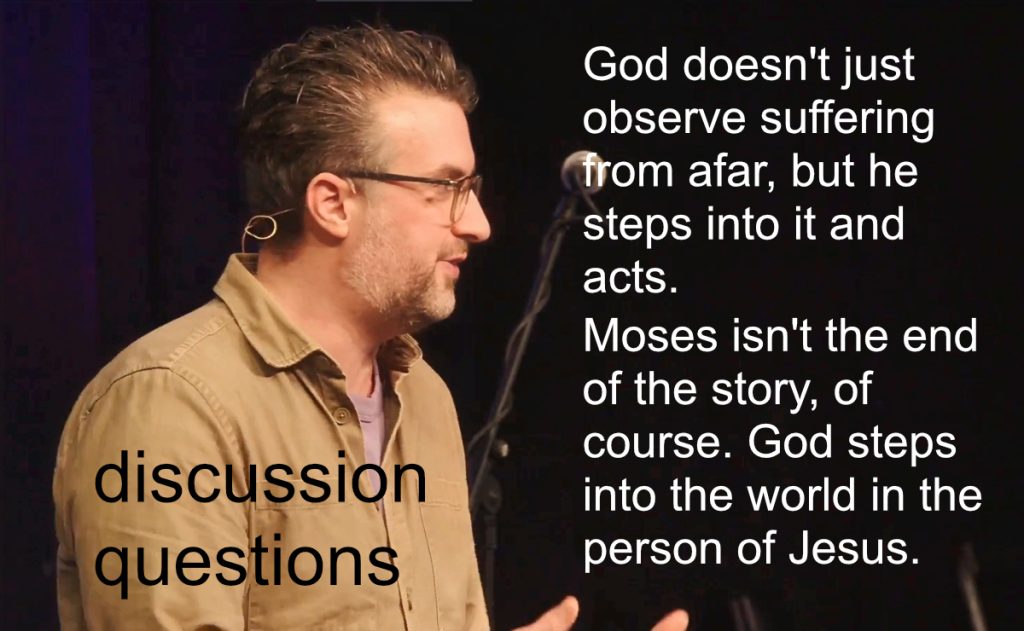
Here are some simple, family-friendly discussion starters you can use around the table. You don’t need to use them all at once—just pick a few that fit your children’s ages and your time.
1. God Hears, Sees, and Knows Us
- The sermon said: “God hears… God sees… God knows us by name.”
- When have you felt like God really heard you?
- Is there anything you are “groaning” about right now that you’d like God to hear?
- How does it make you feel to know God knows your name and your story?
2. Moses at Rock Bottom
- Moses met God at his lowest point, not at his best.
- Have you ever made a big mistake and wanted to run away like Moses?
- What would you want God to say to you in that moment?
- How does Moses’ story change the way you think about God using people with a messy past?
3. The Burning Bush & Holy Ground
- God tells Moses: “Take off your sandals, for the place where you are standing is holy ground.”
- What do you think “holy ground” means?
- Are there places or moments in your life that feel especially close to God?
- If you saw a bush on fire that didn’t burn up, what would you do?
4. God as Holy Fire
- The sermon compared God to fire—powerful, not “safe,” but good.
- What do you think it means that God isn’t “safe” but is good?
- Can you think of something powerful (like a storm, the sea, or a chainsaw) that you respect but still enjoy?
- How should knowing God is powerful change the way we treat him?
5. Covenant and Trust
- God made a covenant (serious promise) with Abraham, Isaac, and Jacob.
- What is the difference between a casual promise (“I’ll take you to the cinema someday”) and a serious promise?
- What promises of God can you think of from the Bible?
- What makes it hard for you to trust God’s promises sometimes?
6. Calling: Moses and Us
- God called Moses by name and gave him a mission.
- If God called your name out loud like he did Moses, how do you think you’d feel?
- Do you think God has a special purpose or calling for you? What might that be right now (at school, work, among friends)?
- What “next step” might God be asking you to take, even if you don’t see the whole plan?
7. Jesus in the Old Testament
- The sermon said the “angel of the Lord” in the burning bush is Jesus appearing before he was born in Bethlehem.
- Had you ever thought about Jesus being in the Old Testament before?
- Why do you think it matters that Jesus has always been part of God’s story, not just in the New Testament?
- What does it show you about God that he keeps stepping into history to rescue people?
8. Exodus and Our Freedom
- Moses led Israel out of physical slavery; Jesus leads us out of slavery to sin and death.
- What do you think “slavery to sin” means in everyday life?
- Are there habits, thoughts, or patterns that can make people feel trapped?
- How can Jesus bring freedom into those areas of our lives?
9. Crying Out vs. Staying Silent
- The preacher asked: “If you’re not crying out about anything—why not?”
- Do you find it easy or hard to be honest with God about how you’re really doing? Why?
- What is one thing you’d like to start talking to God about more openly?
- How can we, as a family, help each other bring our struggles to God?
10. Confession, Forgiveness, and Healing
- The sermon said: confessing sin to God brings forgiveness; confessing to one another can bring healing.
- Why might God want us to share struggles with trusted people, not just keep them hidden?
- How can we be a safe family where people can admit they’re wrong without fear?
- Is there an example (you can keep it general) when bringing something “into the light” helped you?
11. The Promised Land and the Journey
- Freedom from Egypt was like a “down payment” for the promised land; Jesus is leading us to a new heaven and new earth.
- What do you imagine the “new earth” with Jesus will be like?
- How is following Jesus like going on a journey?
- In what ways do you think Jesus is “everything we need” for that journey?
12. When We’re Comfortable
- The sermon also spoke to people who are feeling comfortable, asking if we’re still listening to God.
- When life feels easy, do you tend to move closer to God or drift away a bit?
- What would it look like for us, as a family, to “keep in close step” with Jesus this week?
- Has your love for Jesus ever felt like it’s grown colder? What helped warm it up again?
You can close your discussion by asking each person:
- “What is one thing from Moses’ story or this sermon that you want to remember this week?”
- “What is one small step of trust you want to take with God?”
Then someone can offer a short prayer, thanking God that he hears, sees, knows us by name, and leads us to freedom.
ADULT DISCUSSION QUESTIONS
Moses met God at the lowest point of his life, far from home and living as a fugitive. How does this challenge our assumptions about when and where God calls us to serve Him?
The sermon emphasizes that God’s promises are based on His character and goodness, not ours. How does this truth change the way you approach your relationship with God and your expectations of Him?
God appeared to Moses as holy fire in the burning bush, demonstrating both His power and His restraint. What does it mean to have an appropriate fear of God while also enjoying intimacy with Him?
The passage states that God heard, remembered, saw, and knew the Israelites by name in their suffering. Which of these four actions of God speaks most powerfully to your current circumstances and why?
Jacob’s blessing shifted from being earned through his own trickery to being received directly from God after wrestling with the divine. In what areas of your life are you still trying to engineer your own blessings rather than trusting God’s provision?
The sermon identifies the angel of the Lord in Exodus as Jesus appearing in the Old Testament. How does recognizing Jesus throughout the entire biblical narrative deepen your understanding of God’s redemptive plan?
Moses was called to lead Israel to freedom but never entered the promised land himself. How do you reconcile serving God faithfully while not always seeing the full fruit of your obedience in your lifetime?
The sermon states that confessing sins to God brings forgiveness, but confessing to one another brings healing. What prevents us from bringing hidden struggles into the light with trusted believers?
Jesus declared that He is the way, the truth, and the life, essentially saying He is the journey itself. What does it practically look like to trust Jesus as your journey rather than just your destination?
The sermon asks whether our love for Jesus has grown cold and challenges us to maintain close step with Him. What spiritual practices or disciplines help you keep your love for Christ burning rather than cooling?
0 Comments