
The Beauty of Creation: Reflecting on God’s Artistry
Have you ever paused to marvel at the world around you? From the vibrant hues of autumn leaves to the gentle crash of waves on a shore, or the innocent smile of a baby – our world is filled with breathtaking beauty. But have you ever wondered where all this beauty comes from?
While we often grapple with the question of why there’s so much suffering in the world, today let’s ponder an equally profound question: Why is there so much beauty, love, and goodness in our world?
If we are merely the result of random chance, a cosmic accident, why do our hearts yearn for beauty? Why do we stand in awe before majestic mountains? Why does a piece of music move us to tears? Why does an act of unexpected kindness fill us with warmth?
Just as a beautiful garden implies a gardener, and a delicious meal suggests a skilled chef, the beauty we see around us points to a Creator. Left to their own devices, gardens grow wild and kitchens become messy. But beauty? Beauty always leads us back to its source.
The Bible begins with a powerful declaration: “In the beginning, God created the heavens and the earth.” It goes on to describe how God spoke the world into existence, bringing order out of chaos, form out of formlessness. With each act of creation, God declares it “good,” and upon creating humans, He sees all He has made and pronounces it “very good.”
But what exactly is beauty? While we can recognize it instantly, defining it can be challenging. Beauty encompasses pleasing forms, shapes, colors, and symmetry. It’s attractive to all our senses – sight, smell, hearing, and touch. Perhaps most importantly, beauty is what’s pleasing to the mind and spirit. It’s a holistic concept that engages our entire being.
We can categorize beauty into several areas:
- Nature: The breathtaking landscapes and sunsets that God has crafted.
- Art: The paintings, sculptures, and music that humans create to capture and express beauty.
- People: Not just physical appearance, but the attractive qualities that make us want to spend time with someone – their laughter, their authenticity, their spirit.
- Ideas and Actions: The elegance of language, the precision of mathematics, the “aha” moment of understanding something new.
At the heart of it all, God is the ultimate source of beauty. As Psalm 27:4 expresses, “One thing I ask from the Lord, this only do I seek: that I may dwell in the house of the Lord all the days of my life, to gaze on the beauty of the Lord and to seek him in his temple.”
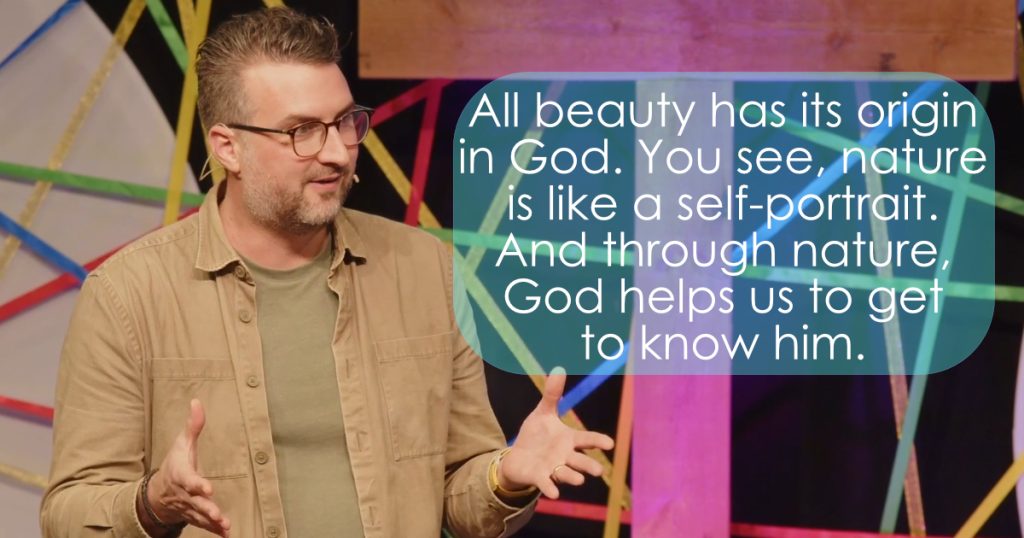
Nature serves as God’s self-portrait, helping us get to know Him better. Psalm 19 declares, “The heavens declare the glory of God; the skies proclaim the work of his hands.” Similarly, Romans 1:20 reminds us that God’s “invisible qualities—his eternal power and divine nature—have been clearly seen, being understood from what has been made.”
Just as manufactured items bear the stamp “Made in China,” all of creation bears the unmistakable mark “Made by God.” Throughout the Bible, we see God’s absolute control over the material world – from the fish that swallowed Jonah to Jesus calming the storm with a word.
The creation narrative in Genesis shows us a good God who is in complete control, bringing order out of chaos simply by speaking. It’s no coincidence that Jesus is described as the Word of God, “through whom all things were made” (John 1:3).
Interestingly, Genesis doesn’t even name the sun and moon directly, referring to them as “the greater light” and “the lesser light.” This subtly discourages the common ancient practice of worshipping celestial bodies, directing our attention instead to the Creator behind them.
The structure of the creation account itself reveals God’s orderly nature. The first three days focus on God bringing form – separating light from darkness, waters to form sky and sea, and sea from dry land. The next three days mirror this, filling these spaces – lights for day and night, birds and fish for sky and sea, and animals and humans for the land.
But what is the most beautiful thing in all creation? It’s love – self-denying, edifying love. God Himself is love, the kind of love that creates, recreates, restores, and heals. The Trinity – Father, Son, and Holy Spirit – embodies a loving relationship at the very heart of God, and creation reflects this divine love.
So how should we respond to the beauty around us?
- Prayer and Worship: Let creation inspire our praise to God. When we pray, let’s first look upward and outward, acknowledging the vastness of our Creator before presenting our requests.
- Meditation: Take time to contemplate God’s beauty directly. As Philippians 4:8-9 encourages us, “Whatever is true, whatever is noble, whatever is right, whatever is pure, whatever is lovely, whatever is admirable—if anything is excellent or praiseworthy—think about such things.”
- Seeing Others: View the people around you – family, coworkers, even difficult individuals – through the lens of their God-given beauty. Everyone, regardless of appearance or status, carries the image of their Creator.
- Stewardship: Recognize our responsibility to nurture and care for the beautiful world God has entrusted to us, rather than exploiting it selfishly.
- Self-Reflection: Avoid two common traps in how we view ourselves. Don’t think you’re too broken for God to love – He created you in His image and sees you as “very good.” But also don’t assume you don’t need to change – we’ve all failed to fully reflect God’s beauty in our lives.
Remember, God is not only the source of all beauty but also the God of restoration. He wants to restore us and empower us to be agents of restoration in the world around us – in nature, in relationships, and in our communities.
As we go about our days, let’s open our eyes to the beauty that surrounds us. Let it remind us of our beautiful Creator, and let it inspire us to bring more of His beauty into the world through our words, actions, and lives. For in doing so, we fulfill our purpose as bearers of God’s image, reflecting His glory and goodness to all we encounter.
0 Comments