
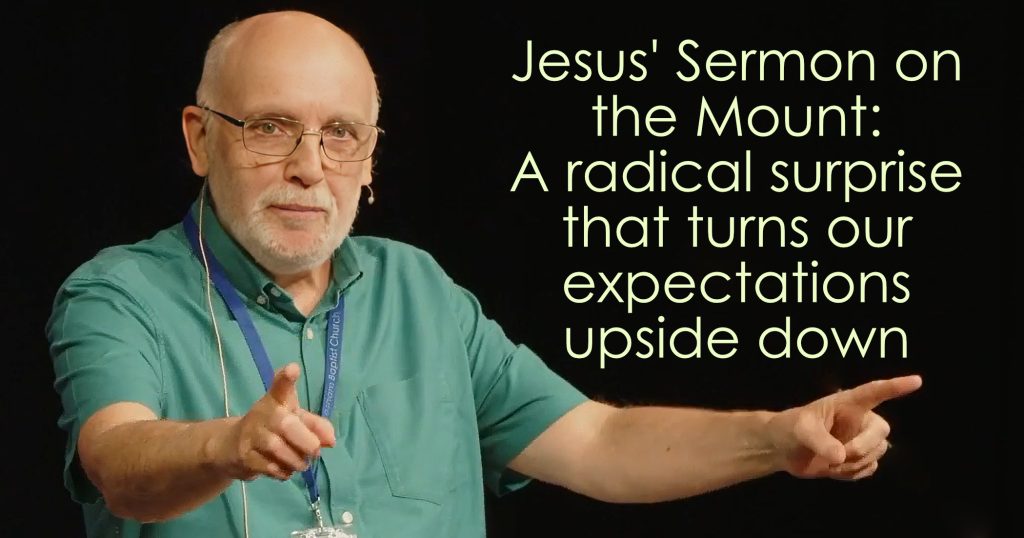
There’s an anticipation in the air, a feeling that something extraordinary is on the horizon. Like a scene from West Side Story, we can sense that “something’s coming” – something great is just around the corner. As we turn our attention to the opening verses of the Sermon on the Mount, we find ourselves at the precipice of a transformative moment in spiritual history.
Mountains in scripture are never mere geographical features; they are signposts of significance. When we encounter a mountain in the Bible, it’s as if God is saying, “Pay attention! Something momentous is about to unfold.” The Sermon on the Mount is no exception. As Jesus ascends the mountainside, we’re invited to climb with Him, to elevate our perspective and prepare our hearts for a revolutionary teaching.
At first glance, what unfolds might seem underwhelming. There are no pyrotechnics, no miraculous healings, no supernatural manifestations. Instead, we find Jesus doing something deceptively simple: He opens His mouth and begins to teach. Yet in this act of speaking, we witness the power of the divine Word – the same creative force that spoke the universe into existence in Genesis 1. As Jesus teaches, He isn’t just imparting information; He’s initiating a new creation in the hearts and minds of His listeners.
This teaching isn’t meant for casual bystanders or curiosity seekers. Jesus sees the crowds, but His words are targeted specifically to His disciples – those who have committed to following Him closely. The Sermon on the Mount isn’t a universal ethical code or a blueprint for societal reform. It’s an intimate discourse for those who have chosen to walk in step with Jesus, challenging them to a radical way of living that can only be achieved through deep relationship with Him.
Consider the gravity of Jesus’ words: “You have heard it said, ‘Do not murder,’ but I tell you that even anger against a brother or sister is subject to judgment.” Or, “You have heard it said, ‘Do not commit adultery,’ but I tell you that anyone who looks at a woman lustfully has already committed adultery with her in his heart.” These teachings aren’t just raising the bar; they’re setting a standard that seems humanly impossible to achieve.
And that’s precisely the point. The Sermon on the Mount isn’t a checklist of behaviors to master through sheer willpower. It’s an invitation to a transformed life that’s only possible through the indwelling presence of Christ Himself. As Archbishop William Temple beautifully articulated, “If the spirit of Jesus could come and live in me, then I could live a life like Jesus.” This is the heart of discipleship – not striving to imitate Christ from a distance, but allowing His very life to take root within us.
But here’s where the teaching takes an unexpected turn. When Jesus begins to describe the blessed life – the life of true flourishing in God’s kingdom – He paints a picture that would have shocked His original audience and continues to challenge us today. “Blessed are the poor in spirit… those who mourn… the meek… those who hunger and thirst for righteousness… the merciful… the pure in heart… the peacemakers… those who are persecuted because of righteousness.”
In a world that equates blessing with wealth, power, and comfort, Jesus turns our expectations upside down. He doesn’t say these difficult circumstances will eventually lead to blessing; He declares that those experiencing them are blessed now. It’s a radical reframing of what it means to be favored by God.
This teaching would have been particularly startling in a culture where strength was prized, the rich were seen as divinely favored, and the poor and suffering were often forgotten or despised. Jesus is announcing that the Kingdom of God operates on an entirely different value system than the kingdoms of this world.
Even today, we often struggle to fully embrace this counter-cultural message. We’ve been conditioned to see blessing in terms of success, physical beauty, material possessions, or large, thriving churches. But Jesus consistently points us to a different reality. He draws our attention to those on the margins – the flood victims in India, the persecuted believers in Nigeria, the faithful who face legal challenges for standing up for their convictions, the employee who loses their job for adhering to biblical principles.
This isn’t to glorify suffering for its own sake, but to recognize that often it’s in these places of weakness and dependence that we’re most open to experiencing God’s presence and power. It’s a reminder that the Kingdom of God advances not through worldly might, but through the seemingly foolish things that confound human wisdom.
As we reflect on these teachings, we’re invited to recalibrate our spiritual senses. What if we approached each day expecting to be surprised by God? Neuroscience tells us that surprises are actually good for our brains, increasing focus and intensifying our emotions. Perhaps this is why Jesus’ teachings often come in the form of unexpected parables and paradoxes – they’re designed to jolt us out of our complacency and awaken us to new spiritual realities.
The challenge before us is clear: Will we be content to admire Jesus’ teachings from a distance, or will we dare to step into the inner circle of true discipleship? Will we receive these words not just as interesting ideas, but as life-altering truth? Are we prepared to have our understanding of blessing and success completely rewritten?
As we journey through the Sermon on the Mount, may we come with open hearts and minds, ready to be challenged, comforted, and changed. May we be willing to shed our “WEIRD” perspectives (Western, Educated, Industrialized, Rich, and Democratic) and embrace the countercultural wisdom of the Kingdom. And may we, like those first disciples on the mountainside, find ourselves transformed by the living Word of God.
Something great is indeed coming. It’s the inbreaking of God’s Kingdom, manifest in the lives of ordinary people who dare to take Jesus at His word. As we lean into these teachings, may we discover the true blessing of a life fully surrendered to Christ – a life that may look foolish by worldly standards, but is infused with the power and presence of God Himself.
0 Comments